
Care guide
Money tree care
Pachira aquatica
A money tree likes bright filtered light and potting mix that dries between waterings. Empty the saucer after 15 minutes: its swamp origins do not justify leaving roots in water. Repot in spring, preserve the braided trunks and watch its response to changes of position.
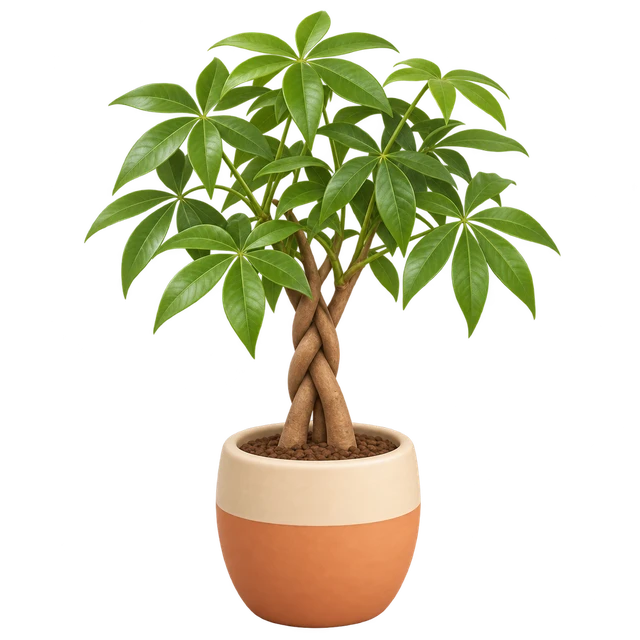
How should you water a money tree?
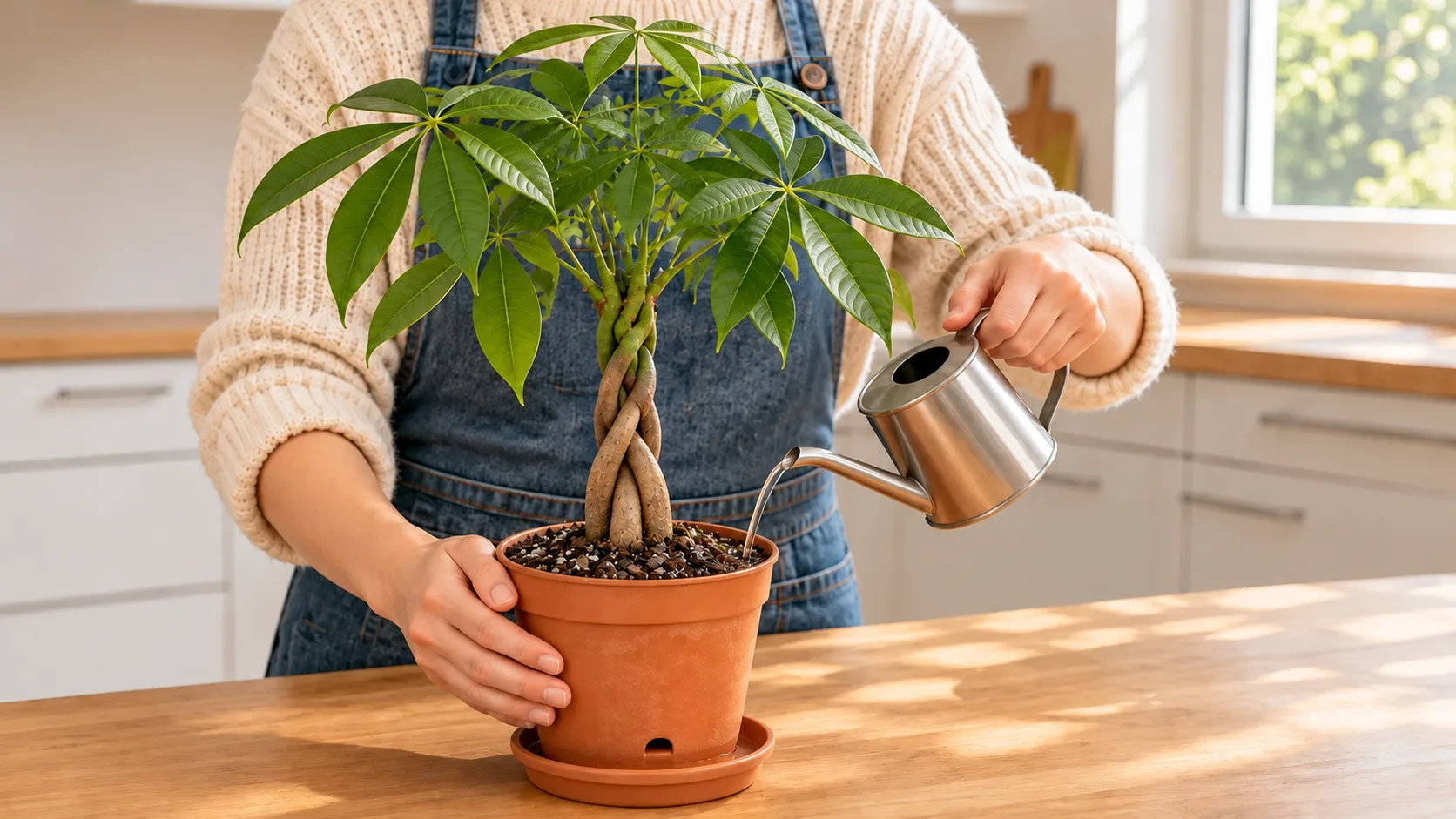
Water thoroughly when the potting mix has almost dried, then empty the saucer after 15 minutes. A money tree grows in wet areas of tropical America, but its potted roots cannot tolerate sitting in stagnant water. A container with drainage holes lets you moisten the whole root ball without keeping its bottom underwater. 1 2
10 L every 30 days
Touch the mix before every watering. In winter, wait until the top few centimetres are dry; the surface alone can dry while the centre stays damp. Pour slowly onto the mix, beside the trunks, until water comes out beneath the pot. Let it drain and also check the bottom of the outer pot. Avoid regularly wetting the braid. 3 1
The pot's weight provides a second clue: a drying pot becomes lighter. Compare it after draining and before the next watering, without relying only on the appearance of the surface layer. This observation lets you follow your own mix, even if the container hides the compost. 4
The rhythm changes with light and heating. A dark room slows drying; a heated flat can instead speed it up. Do not replace checking with a fixed watering every Sunday. Yellow leaves with a softening trunk call for checking overwatering before adding water. 1
The watering guides by plant help you adapt soil checks to the container and foliage.
What light suits a money tree?
Choose bright filtered light and protect leaves from scorching direct sun. Near a bright window, a money tree keeps fuller foliage than in a dark corner. Its young leaves would naturally be protected by taller trees; hot sun through glass can scorch them. 1
Garden exposure
Choose the side of the house where Money tree will grow.
Find where rays actually reach the leaves. If strong sun strikes them, add a sheer curtain or move the pot slightly. Outdoor trees, glazing and orientation change the light reaching the foliage. Light shade is tolerated, but prolonged low light can spoil its shape. Turn the pot at every watering to balance growth. 2 1
Then keep the money tree in the same position. Constantly moving it between rooms can cause leaf drop. For a trailing plant in a dimmer area, compare its needs with pothos.
What humidity should you maintain around a money tree?
Ambient humidity around 50% helps a money tree through a heated winter. Dry edges and curling leaves can accompany dry air, but also insufficient light or irregular watering. Check these three conditions before treating the foliage. 1
Move the pot away from heating vents. A damp gravel tray, with the pot base above the water, is one option suggested for this species. Misting briefly raises humidity around leaves; it replaces neither root-ball watering nor adjustment of room air. More humid air does not justify leaving potting mix waterlogged. 1 4
When and how should you repot a money tree?
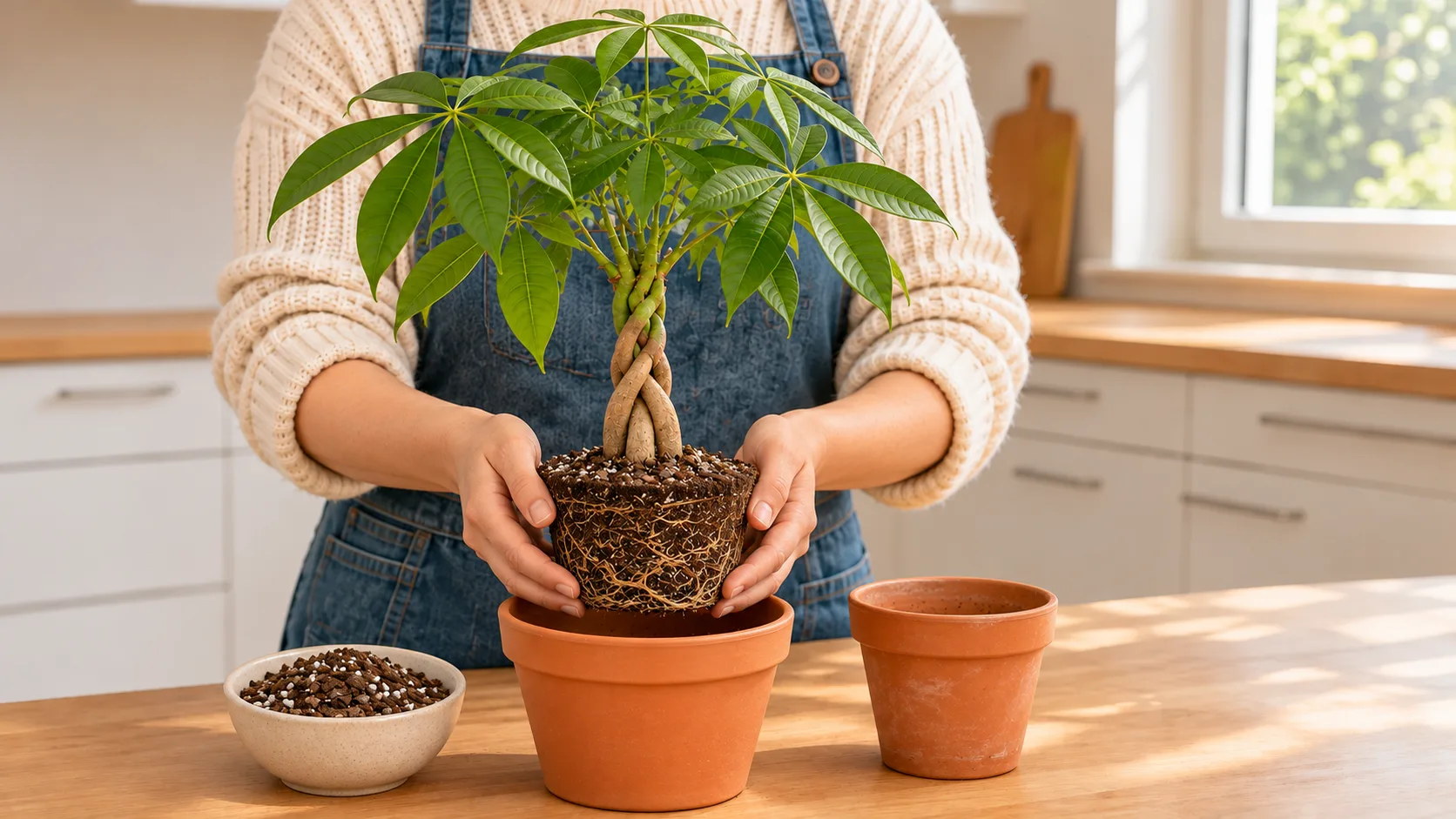
Repot every two or three years, in spring, into a pot only slightly larger. A money tree can lose leaves if its roots are disturbed too much. Prepare the container and mix before unpotting, then support the root ball rather than pulling on the braided trunks. 1
- Repot
- Every 2 to 3 yearsindoorsSource: New York Botanical Garden
- When to repot
- In springSource: New York Botanical Garden
- The new pot
- 2,5 to 5 cm widerOld pot less than 25 cm in both diameter and depthSource: Royal Horticultural Society
For an old pot measuring less than 25 cm (10 in) in both diameter and depth, the general guide is to add about 2.5 to 5 cm (1 to 2 in) to both dimensions. The new container must be no more than a third larger. An oversized pot leaves a large volume of fresh, damp compost around a small root ball. 5
Use houseplant potting compost that is both rich in organic matter and free-draining. Perlite or coarse sand improves aeration; coir retains some moisture. Do not pack roots into a compact mix. Replace the root ball without unnecessarily breaking it up, fill the sides and water to bring compost into contact with roots. Water must be able to escape immediately. 1 5
See the repotting techniques to prepare the container and handle the root ball.
Which fertiliser should you give a money tree?
Apply balanced organic fertiliser at half strength every two weeks from March to September. This programme is for a growing money tree with enough light and controlled watering. Fertiliser is not a way to restart a plant whose roots are rotting. 1
- Fertilizer
- BalancedLiquidSource: New York Botanical Garden
- Feeding
- March to SeptemberindoorsSource: New York Botanical Garden
- No fertilizer
- In winterSource: New York Botanical Garden
- Frequency
- Every 14 daysBalanced fertilizer at half strength, March to September · indoorsSource: New York Botanical Garden
Calculate half strength from the dilution shown on the product. Measure it rather than adding a capful without checking its concentration. Stop feeding in winter. If a money tree loses leaves after a move or repotting, first stabilise its growing conditions: fertiliser cannot correct root shock or insufficient light. 1
How do you prune a money tree without cutting the braid?
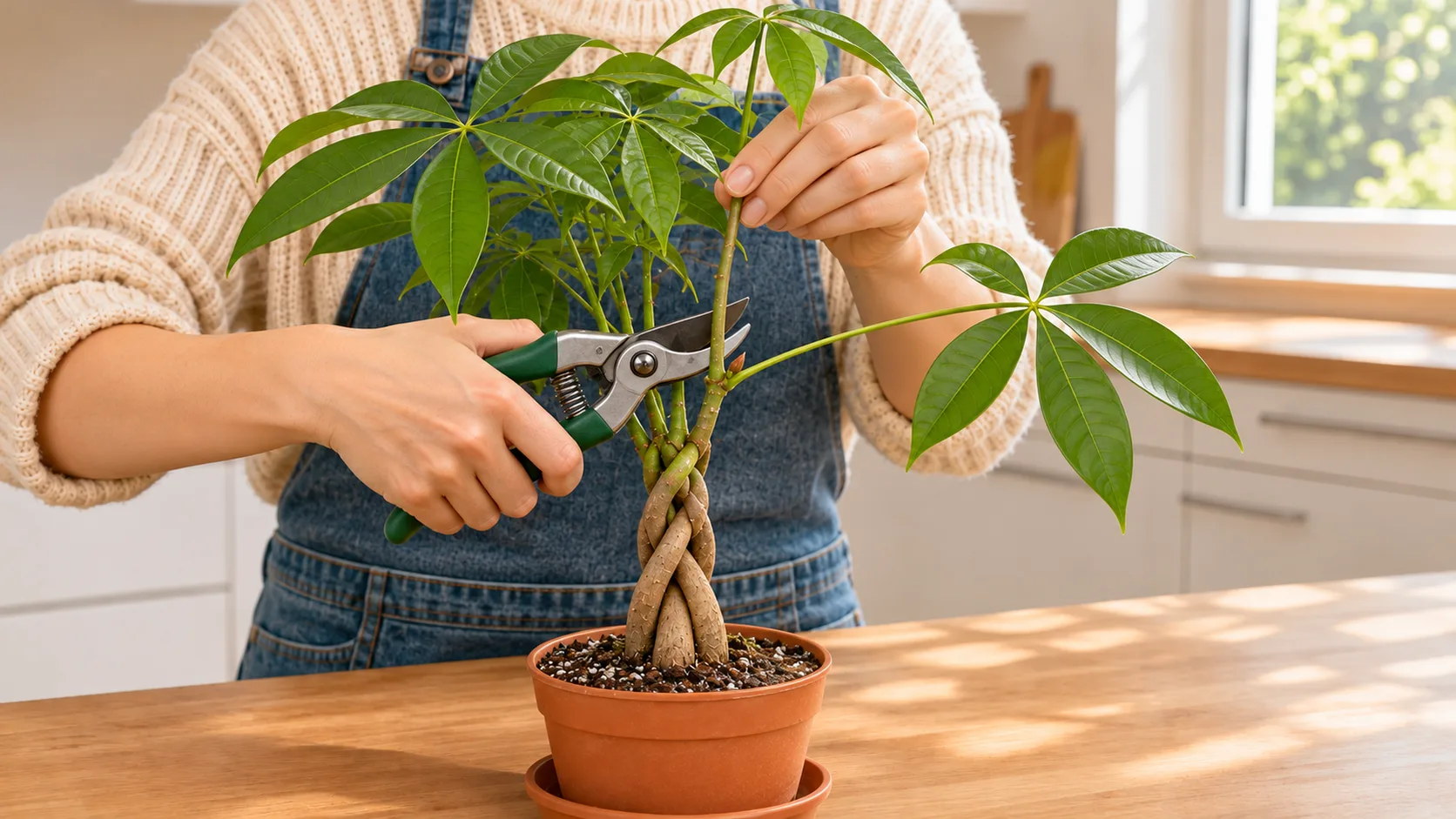
Shorten shoots in spring and do not cut into the braided part. Cut about 1 cm (0.4 in) above a leaf or node, the junction from which new shoots can develop. Do not remove more than half a branch's length. 1
First observe the whole outline. Choose the overlong branch, trace its attachment to the trunk, then locate the node that will stay below the cut. Use sharp, clean secateurs. A single leaflet at the end of its stalk is not a branch: cutting it does not shorten the axis supporting the crown.
Dead leaves or branches can be removed at any time, as can unwanted trunk shoots. To reduce a healthy plant's size, light annual pruning is easier to manage than a substantial late cutback. Avoid shaping an already weakened plant. 1
The pruning guides describe techniques according to the plant and the part to retain.
What winter temperature does a money tree need?
Keep a money tree above 10 °C (50 °F) and away from cold draughts. For growth, a room around 18 to 24 °C (64 to 75 °F) is suitable. Do not leave leaves behind a closed curtain in winter either: air can be much colder between fabric and glass. Bring the plant closer to light by day without exposing it to this cold pocket at night. 4 A cold entrance, a partly open winter window or air-conditioning airflow can cause leaf drop even if the rest of the room is heated. 3 2 1
Temperatures for Money tree
In °C, thresholds given by the sources.
- Recommended minimum for cultivation10 °C
- Ideal: 18 to 24 °C
- Comfortable indoor conditions: 18 to 24 °C
- Winter conditions
- Indoors all yearSource: Floralens guide
- Light
- A bright roomSource: New York Botanical Garden
- Winter watering
- Adjust to the actual drying of the root ballSource: New York Botanical Garden
In winter, retain a bright position and check the mix's moisture before watering. Do not assume every money tree uses less water: heating can speed drying while short days slow it. The root ball's condition determines which situation applies. 1
How tall does an indoor money tree grow?
An indoor money tree can reach about 1.8 to 2.4 m (6 to 8 ft) when conditions suit it. This height does not describe large tropical trees, which can exceed 20 m (66 ft). Pruning shoots and growing in a pot limit its size in a home. 2 6
- Mature height
- 1,8 to 2,4 m
- Spread
- 0,6 to 1 m
- Growth
- Vigorous growth in warm, bright conditions
Before positioning it, also look at the space available for its palmate leaves. Each leaf bears several long leaflets, arranged like fingers at the end of a single stalk. They need a place where passing people will not constantly crush them. A compact young plant has not yet reached its mature crown's spread. 7
What care does a money tree need through the seasons?
Reserve spring for repotting and pruning, then feed the plant from March to September. These tasks accompany renewed growth. Avoid combining root-disturbing repotting with heavy pruning on a weak specimen. 1
| Task | January | February | March | April | May | June | July | August | September | October | November | December |
|---|---|---|---|---|---|---|---|---|---|---|---|---|
| Watering | reduced | reduced | moderate | moderate | high | high | high | high | moderate | moderate | reduced | reduced |
| Growth | resting | resting | active | active | strong | strong | strong | strong | active | active | resting | resting |
| Feeding | no | no | yes | yes | yes | yes | yes | yes | yes | no | no | no |
| Repotting | no | no | favorable window | favorable window | favorable window | no | no | no | no | no | no | no |
During the warmer season, follow drying of the mix and development of new leaves. In autumn, stop feeding after September and check whether declining light has changed watering needs. In winter, useful tasks mainly involve checking the root ball, monitoring leaves and protecting against hot or cold airflow. A fallen leaf after a change of position does not require another intervention on the roots. 1
How do you propagate a money tree?
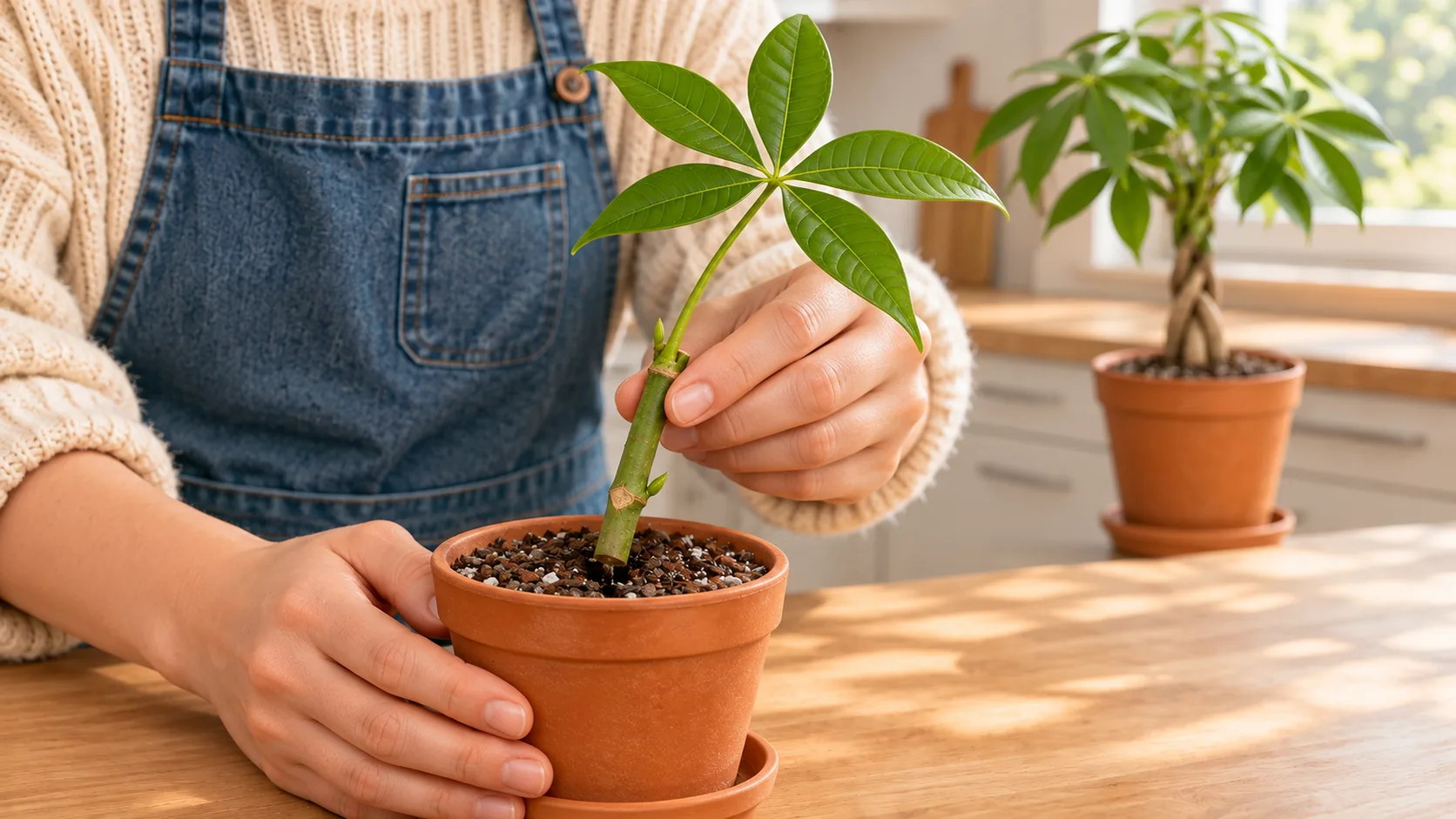
A money tree can be propagated from young stem cuttings, layering or seed. For a home attempt, take a healthy shoot bearing nodes. A single detached leaflet is not the stem cutting used for this species. 2 8
- Softwood cutting
- In springGeneral guideline for herbaceous cuttings · A possible method for Pachira, according to NC StateSource: Royal Horticultural Society
The general softwood-cutting method is used in spring or early summer. Prepare a stem section about 5 to 10 cm long (2 to 4 in), recutting just below a node; remove the lower leaves. Plant its base in cutting compost, leaving the first retained leaf above the mix. This guide applies to softwood cuttings. 9
Water to bring the mix into contact with the stem. A transparent cover limits drying; ventilate it regularly. Do not let the cutting wilt or sit in waterlogged growing medium. The buried part must remain a stem: the node is identified by a leaf's junction with that axis. Keep remaining leaves out of the mix, where they would not help establishment. A dated label helps follow the attempt without removing the cutting to keep inspecting its base. 9
Air layering, also possible, keeps the shoot attached to the plant while roots form. To compare techniques before taking material, see the propagation guides by species. 9 8
Which money tree problems should you watch for?
Yellow leaves alone do not prove underwatering: examine the mix and trunks. A soft trunk with damp mix points towards overwatering. After moving or repotting, leaf drop can also reflect shock without rot. 1
| What you observe | What to check | First action |
|---|---|---|
| Yellow leaves and a softening trunk | Standing water or overly moisture-retentive mix | Empty the outer pot and examine roots |
| Leaf drop after repotting | Disturbed roots | Stabilise the position and wait for new growth |
| Leaves falling after a move | Draught or environmental change | Move the pot away from cold or hot airflow |
| Crisp, curled leaves | Dry air, light or irregular watering | Check all three conditions before treating |
| Discolouration after direct sun | Leaf scorch | Filter sun striking the foliage |
| Tiny pale dots and fine webs | Mites beneath leaves | Isolate the plant and carefully rinse undersides |
If you see fine webs and feeding marks, look beneath leaves for spider mites. Rinsing undersides can reduce their population. Do not apply a homemade soap or oil mixture over the whole crown without knowing what you are treating. 1 2 10
What precautions should you take with money tree seeds?
Keep seeds away from children and pets. Ingestion can cause digestive problems, particularly in cats. 2 In France, call 01 45 42 59 59 for human ingestion, without inducing vomiting; for an animal with symptoms, contact a vet. 11 Details appear in the money tree profile.
Which money tree forms should you choose?
A braided trunk brings together several young plants; it does not define a botanical variety. Flexible trunks are intertwined during production. Check their firmness individually when buying: foliage can hide the base of one plant. 2 1
Tronc tressé
Horticultural name
A horticultural training method in which several young, flexible trunks are braided together, rather than a distinct botanical cultivar.
Pachira glabra
Uncertain status
A distinct species documented under the name Pachira glabra; the trade name “money tree” alone does not confirm the species.
Forme panachée
Horticultural name
A horticultural form of Pachira aquatica with cream variegation and no established cultivar name.
Varieties documented in the botanical profile.
| Form or related plant | Identifying feature | Consequence for care |
|---|---|---|
| Green money tree on a single trunk | Green palmate leaves, one main axis | Maintain bright indirect light |
| Money tree with braided trunks | Several intertwined trunks beneath the crown | Prune shoots without cutting into the braid |
| Variegated form of Pachira aquatica | Leaflets marked with cream-white bands | Retain its identification and monitor pot drying |
| Pachira glabra | Distinct species, also called money tree | Have the species confirmed before applying a specific profile |
Variegated forms exist, but the descriptive label “variegated” does not alone identify a named cultivar. A yellowing leaf on a green plant is not enough to identify variegation. For botanical features and old names, see the money tree profile. 12 7
Frequently asked questions
Can I put my money tree outside?
Yes, during summer, in filtered light. Avoid moving directly from a room into scorching sun. Before bringing it inside in autumn, inspect leaf undersides to avoid introducing pests. Lower indoor light can cause leaf drop during adjustment. 13