
Care guide
Dieffenbachia care
Dieffenbachia seguine
Dieffenbachia keeps attractive leaves with bright filtered light and potting mix that dries about 2.5 cm deep (1 in) between waterings. Its cane can become bare with age: pruning can renew it. Protect it from cold and keep its irritating sap out of reach of children and pets.
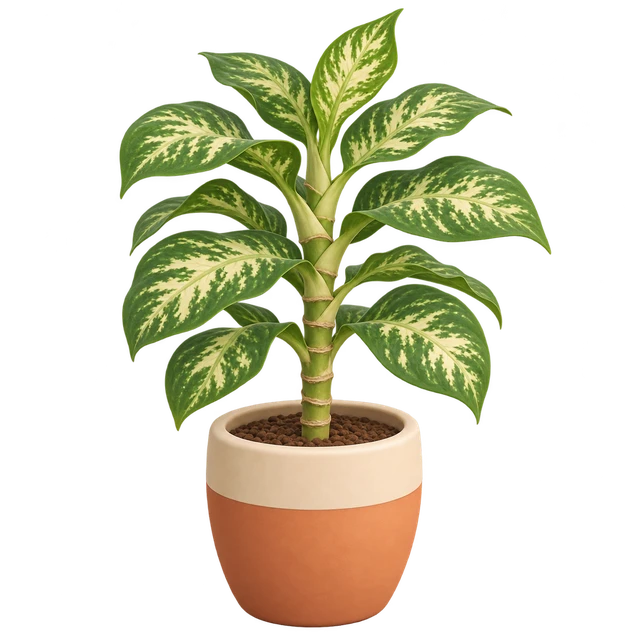
Dieffenbachia (Dieffenbachia seguine) is grown indoors for its variegated leaves. Its fleshy cane can be renewed through pruning or cuttings when it becomes bare. 1
How should you water dieffenbachia?
Wait until the top 2.5 cm of potting mix is dry (1 in) before watering again. Push a finger into the soil rather than judging its colour. Then water the whole root ball, let water drain and empty the outer pot. Dieffenbachia appreciates steady moisture, but roots permanently sitting in water risk rotting. 1 5
When the top 2.5 cm is dry (1 in)
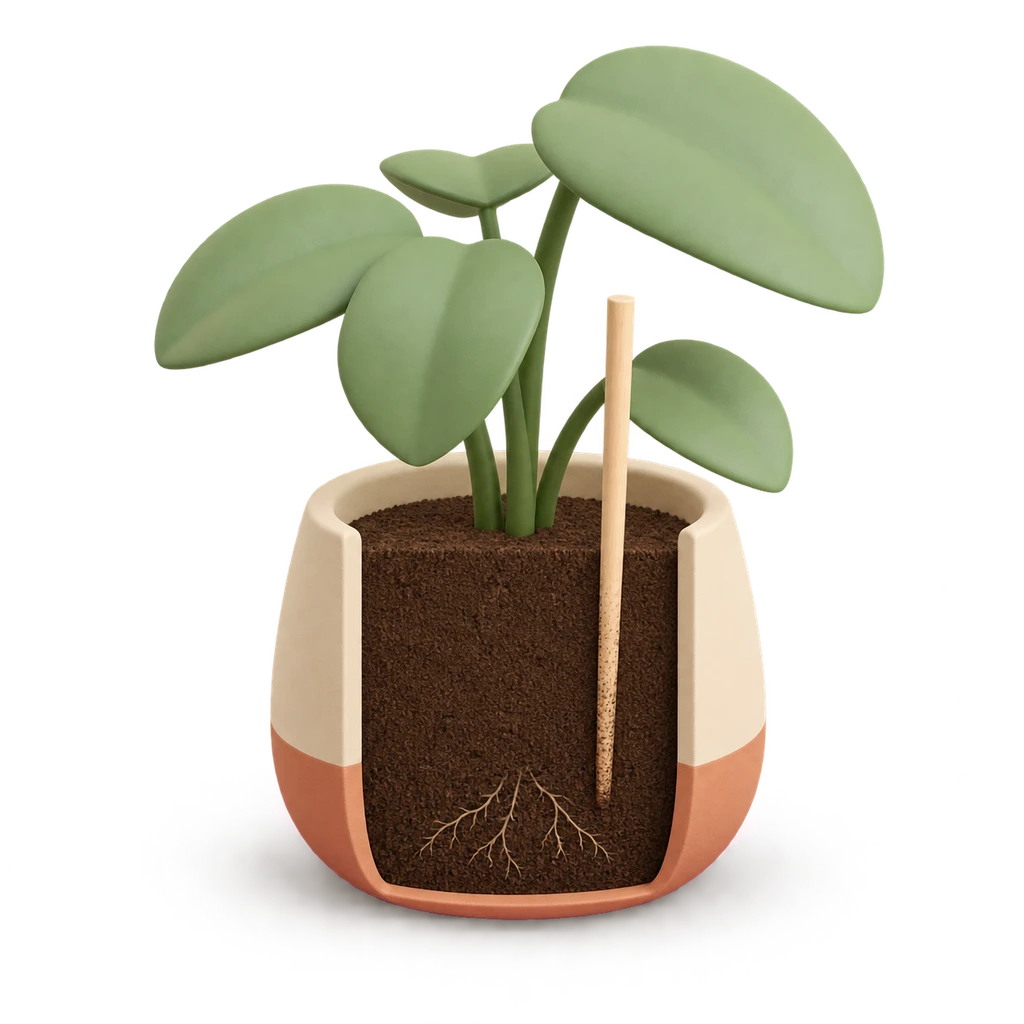
Potting mix dry to 1,3 cm: still moist
The finger test
Push a finger or wooden skewer 2,5 cm into the potting mix: if it is dry, water; if it is still moist, wait. The condition of the mix decides, not the calendar.
Drying slows in a dim room, in winter or after moving to a larger pot. Do not keep the same watering appointment all year. A still-damp surface means you should wait, even if a leaf droops. Conversely, a dry root ball with collapsed leaves calls for thorough watering. 6 5
Water the whole root ball, then drain
Also lift the pot before and after watering: its weight helps you recognise drying in your home. This complements checking by touch without treating a tropical plant as a bog plant. If water remains in the bottom of the outer pot, remove the nursery pot to drain it.
Where should you put dieffenbachia?
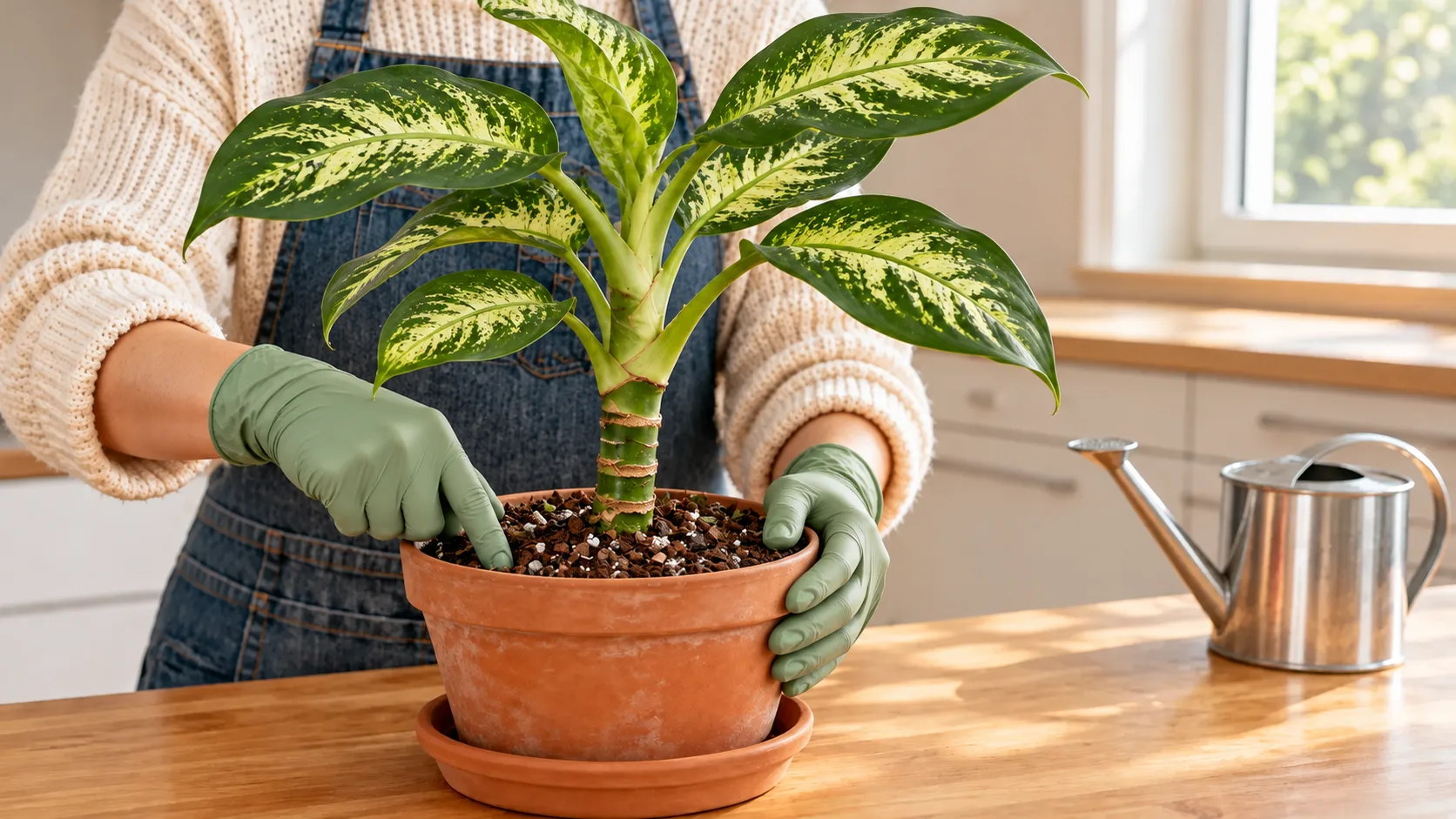
Choose a bright position where direct rays do not strike the leaves. Near a very sunny window, a sheer curtain filters the light. A dark room may let the plant survive, but growth slows; stems lengthen and variegation may lose contrast. Gradually moving the pot closer to the light is then more useful than increasing fertiliser. 1 7
Turn the pot a quarter-turn every few days if all new leaves point towards the window. A leaf paling on the exposed side instead needs protection from sun. Avoid repeated moves between very different conditions. 5 6
Humid air, away from the radiator
Large leaves dry more easily in a hot, dry room. Keep foliage away from the radiator and group plants if space allows. More humid air never removes the need to let the pot's surface dry: air and potting mix need different management. 6
Monstera also appreciates indirect light; its climbing growth, however, needs different space management.
Which potting mix and pot should you choose?
Use a loose, organic-rich, free-draining houseplant potting mix. It must retain enough water to moisten the root ball, then let the excess through. Perlite is among the materials used to open up horticultural dieffenbachia mixes; it cannot compensate for a pot without drainage. 1 6
The mix
- Houseplant potting mixLoose, fertile, free-draining Source: Clemson Extension — Dieffenbachia
- PerliteAerating material, without a prescribed proportion Source: UConn Home & Garden — Dieffenbachia
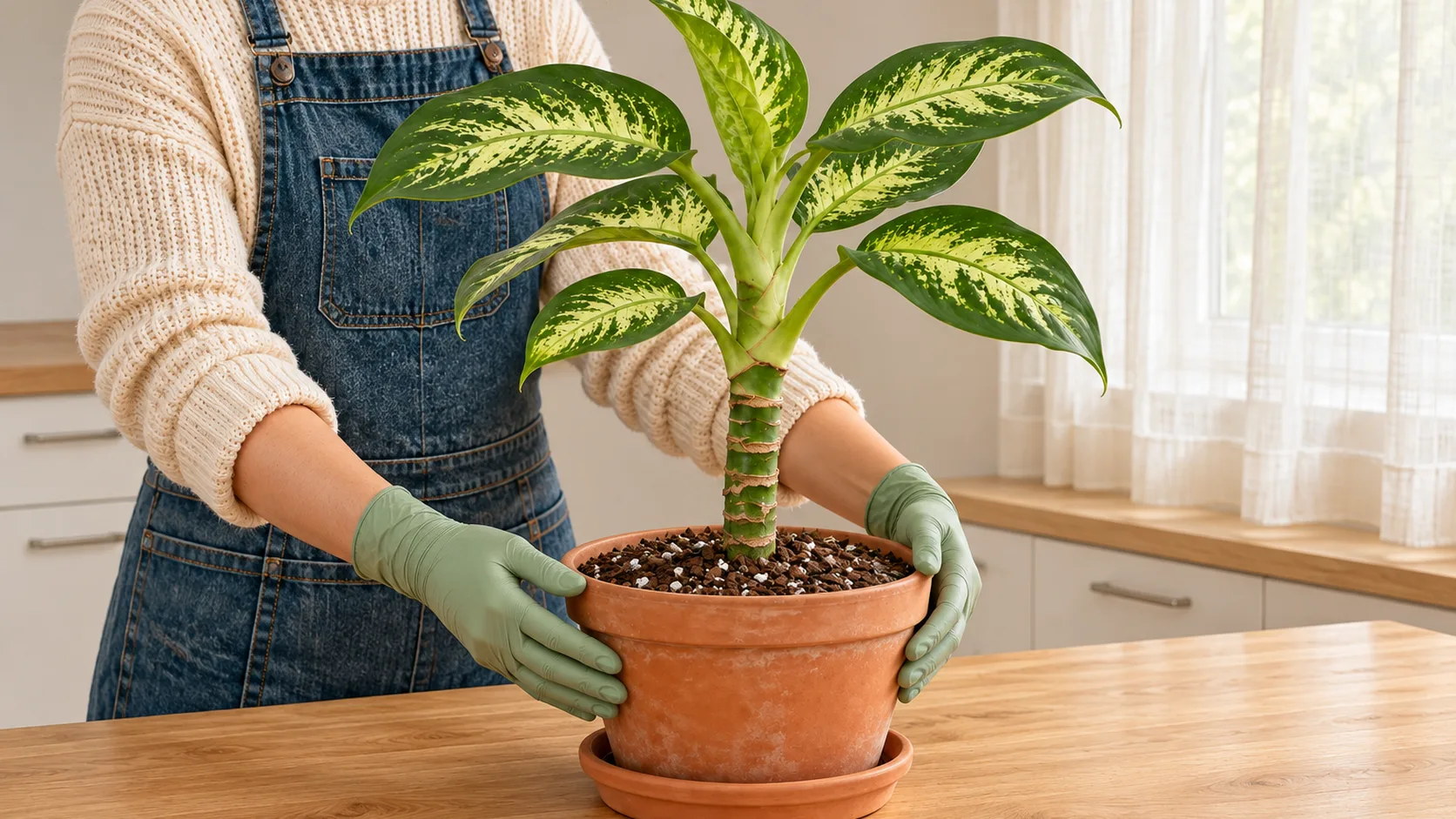
Repot in early spring when the root ball needs room. In houseplants, roots crowded around the root ball or emerging from holes, along with much faster drying, are useful signs. Choose a pot with drainage holes about 2.5 to 5 cm larger in diameter (1 to 2 in) than the previous one: this general guide avoids a large volume of wet soil around small roots. 8 9
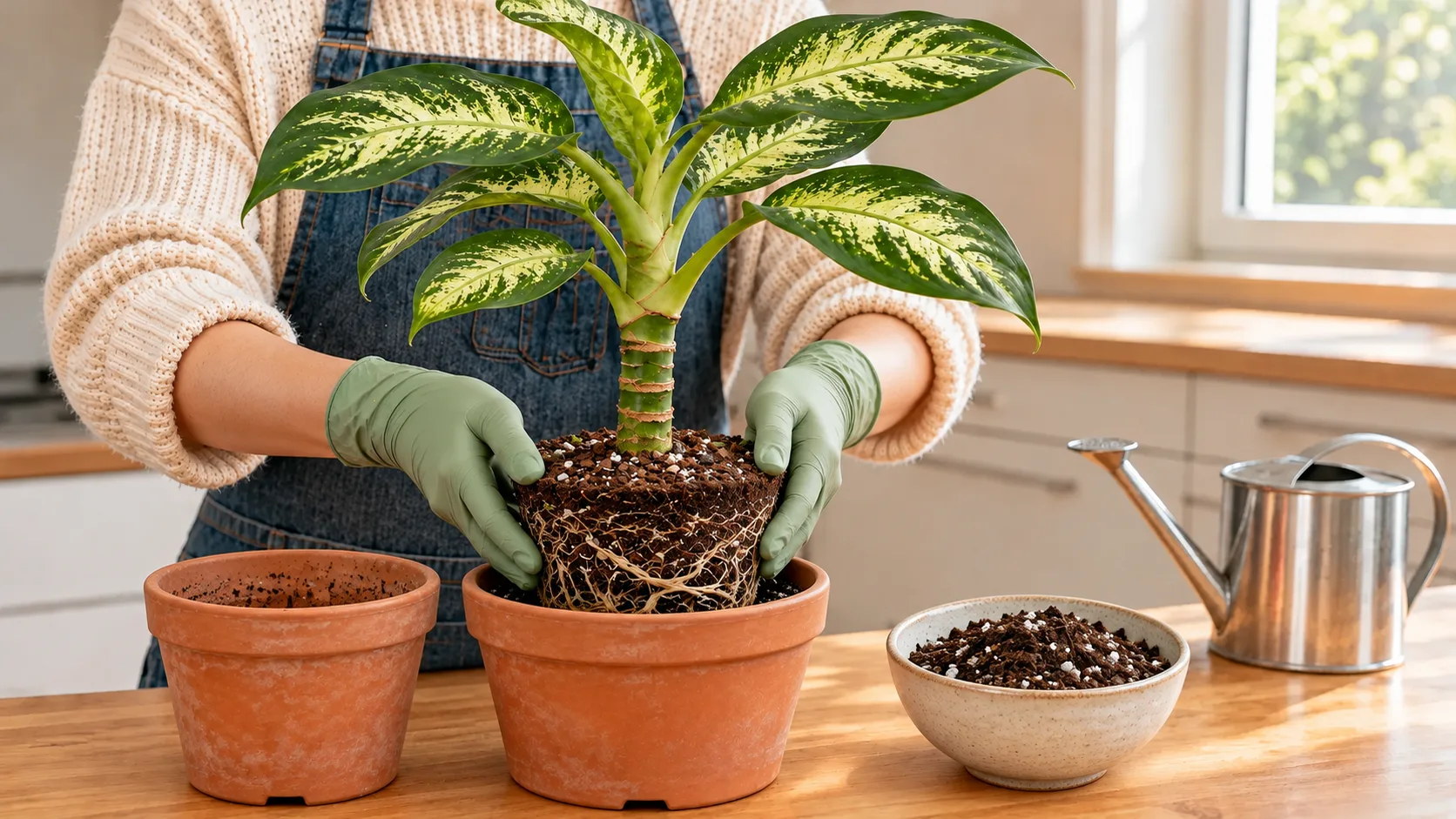
Carefully remove the root ball, loosen the outer roots and replace it at its original depth. Fill the sides without firming heavily, then water and drain. Do not add a layer of stones at the bottom: it slows water movement. Wear gloves, particularly if a leaf stalk breaks during handling. 9 1
To compare techniques by plant, see the repotting guides.
Which fertiliser should you give dieffenbachia?
During active growth, liquid foliage-plant fertiliser is suitable. From March to September, horticultural guidance is a half-strength application every two to four weeks. Monthly feeding is therefore a moderate guide within this range; also respect the limits on the product label. 8
- Fertilizer
- BalancedLiquid, slow-releaseSource: UConn Home & Garden — Dieffenbachia
- Feeding
- March to SeptemberOnly if the plant is growing · indoorsSource: Clemson Extension — Dieffenbachia
- No fertilizer
- During dormancySource: UConn Home & Garden — Dieffenbachia
- Frequency
- Every 14 to 28 daysLiquid fertiliser · At half strength · indoorsSource: Clemson Extension — Dieffenbachia
- Avoid
- Exceeding the dose on the label, feeding during dormancySources: UF/IFAS Gardening Solutions — Dieffenbachia; UConn Home & Garden — Dieffenbachia
A newly bought plant generally needs no fertiliser for at least two months. If it grows little because light is lacking, reduce or stop feeding. Brown, curled margins can indicate excess salts: stop fertilising and flush clear water through the potting mix, letting it all drain away. 7 5
Fertiliser repairs neither a soft base nor suffocated roots. First examine moisture and position when a plant stops producing leaves.
How do you prune a bare dieffenbachia?
A healthy cane that is too tall or bare can be cut back to about 15 cm above the mix (6 in). Old leaves gradually fall, exposing the cane. If you like this outline and the top remains healthy, rejuvenation pruning is unnecessary. A plant that has become too tall or very bare can be cut back to about 15 cm above the mix (6 in); new shoots develop below the cut. 8
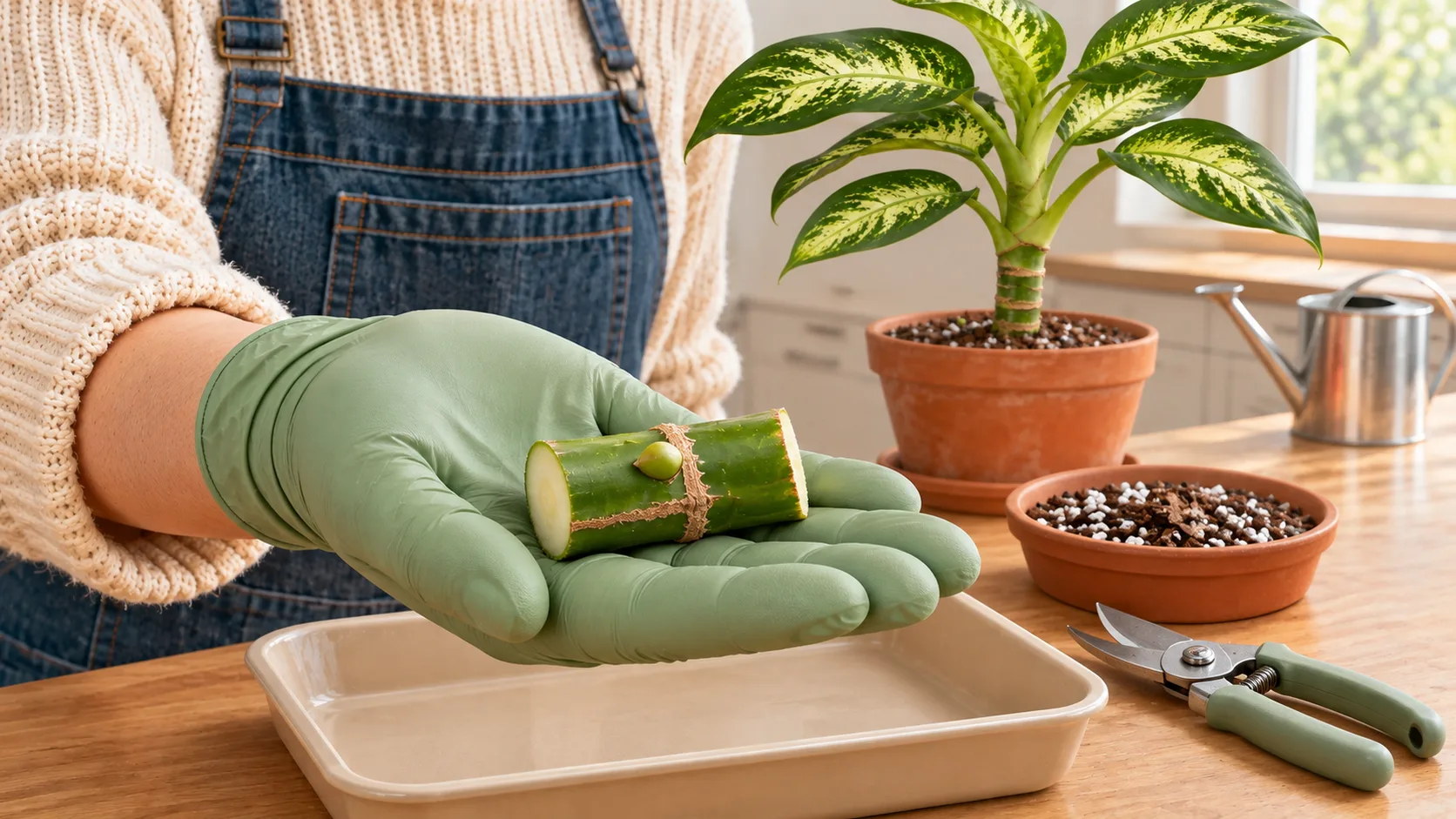
Preferably work when the plant starts growing again, to support recovery in good conditions. Prepare the area before cutting: a washable surface, a clean tool, gloves and no children or pets nearby.
Cut the healthy cane cleanly, collect the pieces immediately and clean the tool. A leafy tip can become a cutting. If the base is soft, wet or foul-smelling, move to diagnosis first: shortening a diseased stem does not guarantee recovery. 1 6
What temperature suits it?
A room around 18 to 24 °C (64 to 75 °F) suits its growth. Focus on stability: an open window in winter, cold glass or a draughty entrance can damage a plant even in a heated home. 6
Temperatures for Dieffenbachia
In °C, thresholds given by the sources.
- Stated minimum for growing the species12 °C
- Avoid cold-related leaf drop13 °C
- Ideal: 18 to 24 °C
- Good indoor growth: 18 to 24 °C
- Protect
- In winterAvoid cold glass and draughtsSource: Floralens guide
- Light
- A bright roomSource: UConn Home & Garden — Dieffenbachia
Keep it above about 13 °C (55 °F) to avoid cold-related leaf drop. The 12 °C minimum (54 °F) given for growing the species remains a lower limit, rather than a winter temperature to seek. Keep dieffenbachia in a bright room; it does not need a cold winter rest. 5 10
During the darker season, space waterings according to actual drying and watch the effects of heating on leaf edges. Do not try to compensate for a dry room by keeping the root ball constantly wet. 6
How large does dieffenbachia grow?
Height depends on the cultivar: about 30 cm (1 ft) for some compact forms, up to 1.80 m (6 ft) or more for large selections. Common dieffenbachias often reach about 90 cm to 1.80 m (3 to 6 ft) in cultivation, while some compact forms stay near 30 cm (1 ft). Large selections can exceed these dimensions. Check the label name before choosing a pot intended to stay on a shelf. 8 5
- Mature height
- 2 to 3 m
- Spread
- 61 to 91 cm
In wild Dieffenbachia seguine, stems can reach 2 to 3 m (7 to 10 ft) and leaves 40 cm (16 in). In a pot, the plant usually stays shorter, but a tall cane may eventually lean over. Growth slows markedly when light is lacking. 10 6
Wipe dusty leaves with a damp cloth, supporting them underneath. Their broad surface needs gentle handling: retain a healthy leaf rather than cutting it simply to even up the plant's outline. 7
Rare flowering in a home
Flowering is rare in a home. It combines a spadix and a greenish spathe that may resemble an unfurling leaf. Flowers are inconspicuous; their absence therefore warrants neither a change of fertiliser nor a move into scorching sun. 6
The plant is grown mainly for its leaves. Continue the same care when an inflorescence appears and keep it, like the rest of the plant, away from people and animals likely to chew it. 5 3
The care calendar
In spring, check the root ball; from March to September, feed only if the plant is growing. Indoors in metropolitan France, room light and new leaves matter more than the date alone. The calendar reflects this seasonality: it helps you remember tasks without prescribing watering on a particular day.
| Task | January | February | March | April | May | June | July | August | September | October | November | December |
|---|---|---|---|---|---|---|---|---|---|---|---|---|
| Watering | reduced | reduced | moderate | high | high | high | high | high | high | moderate | reduced | reduced |
| Growth | resting | resting | active | active | strong | strong | strong | strong | active | active | resting | resting |
| Feeding | no | no | yes | yes | yes | yes | yes | yes | yes | no | no | no |
| Repotting | no | no | favorable window | favorable window | no | no | no | no | no | no | no | no |
As spring returns, examine the root ball and prepare to repot if the roots are crowded. Spring and early summer suit propagation. Feeding from March to September supports a plant that is actually growing. 8
In autumn and winter, always check the soil before watering. Keep the pot away from cold draughts and inspect leaf undersides during maintenance. A heated room can dry the air while leaving the potting mix damp for a long time, particularly in a dim position. 1 6
How do you propagate dieffenbachia?
Propagate a healthy plant using tip cuttings, cane sections, division or air layering. Work in spring or early summer on a healthy specimen. To compare these methods with its natural life cycle, also see the dieffenbachia botanical profile. 8 10
- Stem segment cutting
- In springGrowing medium at least 24 °C (75 °F), with suitable moisture · roots in 3 to 8 weeksSource: Floralens guide
- Stem segment cutting
- In summerEarly summerSource: Clemson Extension — Dieffenbachia
- Division
- During active growthSource: Oxford University Plants 400
- Air layering
- During active growthSource: Oxford University Plants 400
A bare cane can be divided into sections about 5 cm long (2 in), each bearing at least one side bud. Let the cuts dry for a day, then place the sections in an airy rooting medium, for example one based on perlite. A cutting from the top generally roots faster than a basal section. 6
Under horticultural propagation conditions, rooting takes three to eight weeks with the medium kept at least 24 °C (75 °F) and appropriately moist. This time frame describes controlled warm conditions; a cutting on a cooler windowsill may take longer. Do not pull it to check the roots. 7
Sap requires the same precautions as pruning. Label cutting pots and keep them out of reach: small cane pieces are still toxic plant parts. 1
The propagation guides let you compare methods suited to other plants.
Why do the leaves turn yellow or become damaged?
Check the potting mix, the position of affected leaves and the stem's firmness before changing care. A yellow leaf alone cannot identify the cause. Look at its position, touch the mix, check the bottom of the outer pot and examine the stem. This prevents adding water to an already saturated root ball. 6
| What you observe | Cause to check | First action |
|---|---|---|
| An old lower leaf turns yellow, the rest stays firm | Normal ageing | Check that new leaves remain healthy |
| Several lower leaves turn yellow, damp soil | Overwatering | Empty the outer pot and wait for drying |
| Drooping leaves with a dry surface | Underwatering | Water the whole root ball, then drain |
| Leaf drop without yellowing after a cold spell | Temperature too low | Move the plant to a room with stable conditions |
| Brown, curled edges after feeding | Salt accumulation | Stop feeding and flush the mix |
| White cottony clusters on stems and undersides | Mealybugs | Isolate the pot and inspect neighbouring plants |
| Pale leaves and fine webs underneath | Spider mites | Isolate and wash the foliage with water |
| Soft base and wet tissue breaking down | Rot, sometimes bacterial | Isolate and remove affected tissue; do not use it for cuttings |
Signs of watering problems, cold and pests sometimes overlap. Lower leaves can also fall if the position lacks light. Consider all the signs before changing care. 5 6
Soft rot, particularly associated with Dickeya dieffenbachiae, can release an unpleasant smell. 6 Very dark, water-soaked spots with a yellow halo can suggest bacterial disease; appearance alone cannot identify the agent. Avoid splashes, clean tools and separate the sick plant. Diseases described in production are not treated with an extra dose of fertiliser. 11
| What you see | Likely cause | What to do |
|---|---|---|
| Soil stays soggy, suffocating roots and causing rot. | OverwateringExternal Factors | Treating Waterlogged Soil |
| The plant wilts and yellows while the soil stays wet. | Root RotDiseases | Treating Waterlogged Soil |
| The soil is dry and leaves are soft and drooping. | UnderwateringExternal Factors | Rescue by Soaking |
| Stems become soft, translucent, and collapse at the base. | Bacterial Soft RotDiseases | Treating Waterlogged Soil |
| Tiny arachnids that spin fine webs under leaves. | Spider MitesPests | Eliminate Spider Mites |
| White cottony clumps in leaf axils and on stems. | MealybugsPests | Eliminate Armored Scale Insects |
| Brown leaf tips and a white crust on the soil. | Salt BuildupExternal Factors | Flushing Soil Salts |
Is dieffenbachia toxic?
Yes: all parts are irritating and toxic to humans, children, cats, dogs and horses. Wear gloves; keep the plant and waste out of reach. After exposure, contact a poison centre for a person or a vet for an animal. See the risks from its sap. 1 3
Which varieties should you choose?
Choose according to size, available light and leaf pattern. The old names Dieffenbachia maculata and D. picta are assigned to D. seguine. Labels and growing descriptions may still use them. A cultivar name identifies a horticultural selection; it does not automatically mean another species. 12 1
Exotica
Horticultural name
Leaves strongly variegated cream-white, with small green patches and a narrow green margin.
Tropic Snow
Horticultural name
Dark green leaves marked cream along the veins; large cultivar.
Camille
Horticultural name
Cream-yellow leaves edged deep green, full habit.
Varieties documented in the botanical profile.
| Cultivar | Distinctive feature | Consequence for your choice |
|---|---|---|
| ‘Camille’ | Cream-yellow centre, deep green margin and full habit | Suits those seeking a bushy outline; maintain good filtered light |
| ‘Exotica’ | Strong cream-white variegation, small green patches and narrow green margin | Choose for broad cream areas dotted with green |
| ‘Tropic Snow’ | Large dark green leaves marked cream along the veins | Tolerates less light than many other cultivars; allow space |
‘Tropic Snow’ can reach about 1.80 m (6 ft). ‘Camille’ needs more light than some selections sold for dim interiors. None of these differences removes the risk from sap. Choose first according to available space and actual light. 8 1 7
Frequently asked questions
Drops on leaves and an old yellow leaf do not necessarily call for the same action.
Why are there water drops on my plant's leaves?
This may be guttation: drops appear particularly in the morning at leaf tips. The fertiliser salts they contain can remain after evaporation and scorch the tip. Check feeding if these traces accompany browning. 6
Should you cut off yellow dieffenbachia leaves?
Remove an old lower leaf when it yellows and droops naturally, wearing gloves. If several leaves decline together, first examine the mix and temperature: removing leaves does not correct the cause. 5