
Care guide
Anthurium care
Anthurium andraeanum
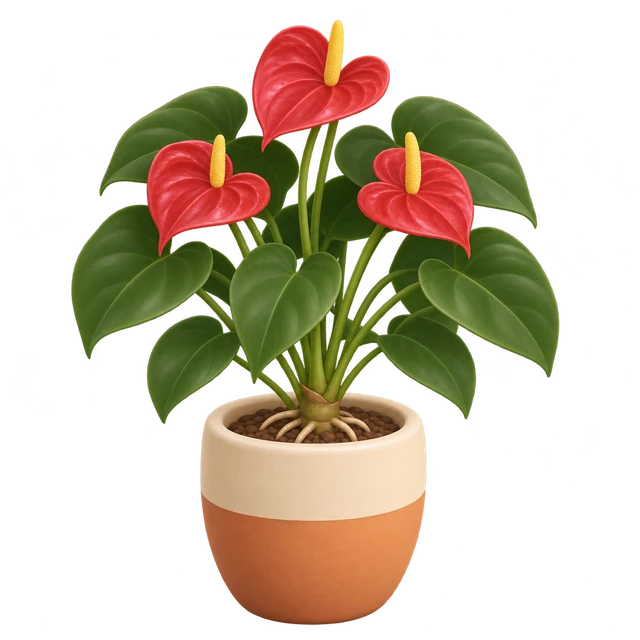
Florist’s anthurium likes a warm room, a bright window without scorching sun and compost that lets its roots breathe. Water when the top 2.5 cm (1 in) has dried, then let it drain. A constantly waterlogged root ball does more harm than a little drying at the surface.
How often should you water an anthurium?
Water florist’s anthurium (Anthurium andraeanum) when the top 2.5 cm (1 in) of compost feels dry, while the compost lower in the pot remains slightly moist. 1 Its roots need both water and air: slight drying between waterings suits an indoor plant, whereas a saturated mix encourages root rot. 2
17 cL every 11 days
Weekly maximum: two
About every 7 days
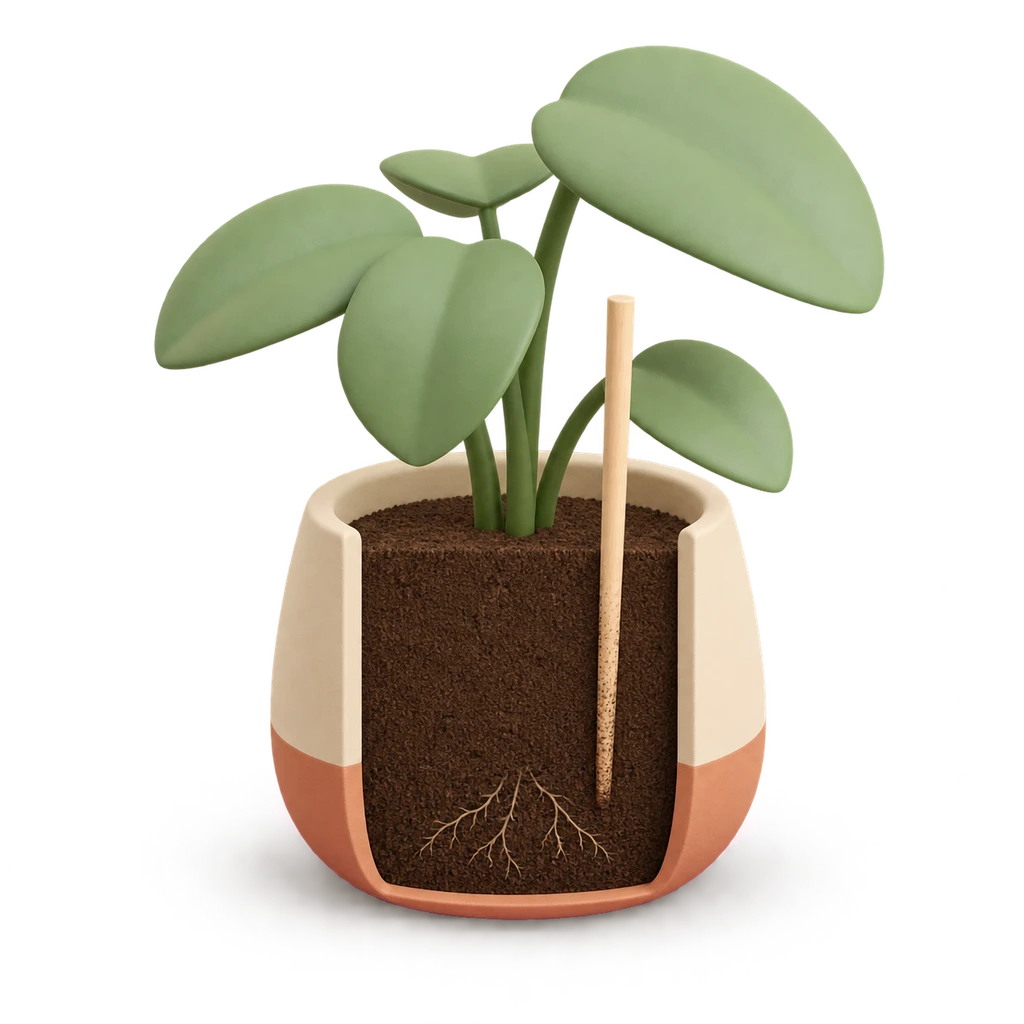
Potting mix dry to 1,3 cm: still moist
The finger test
Push a finger or wooden skewer 2,5 cm into the potting mix: if it is dry, water; if it is still moist, wait. The condition of the mix decides, not the calendar.
A drooping leaf alone is no reason to water. Roots damaged by a waterlogged root ball can no longer supply the leaves properly, giving the same appearance as a shortage of water. 3 Feel the compost before making changes: the overwatering and underwatering guides help distinguish these situations.
Where should you put an anthurium indoors?
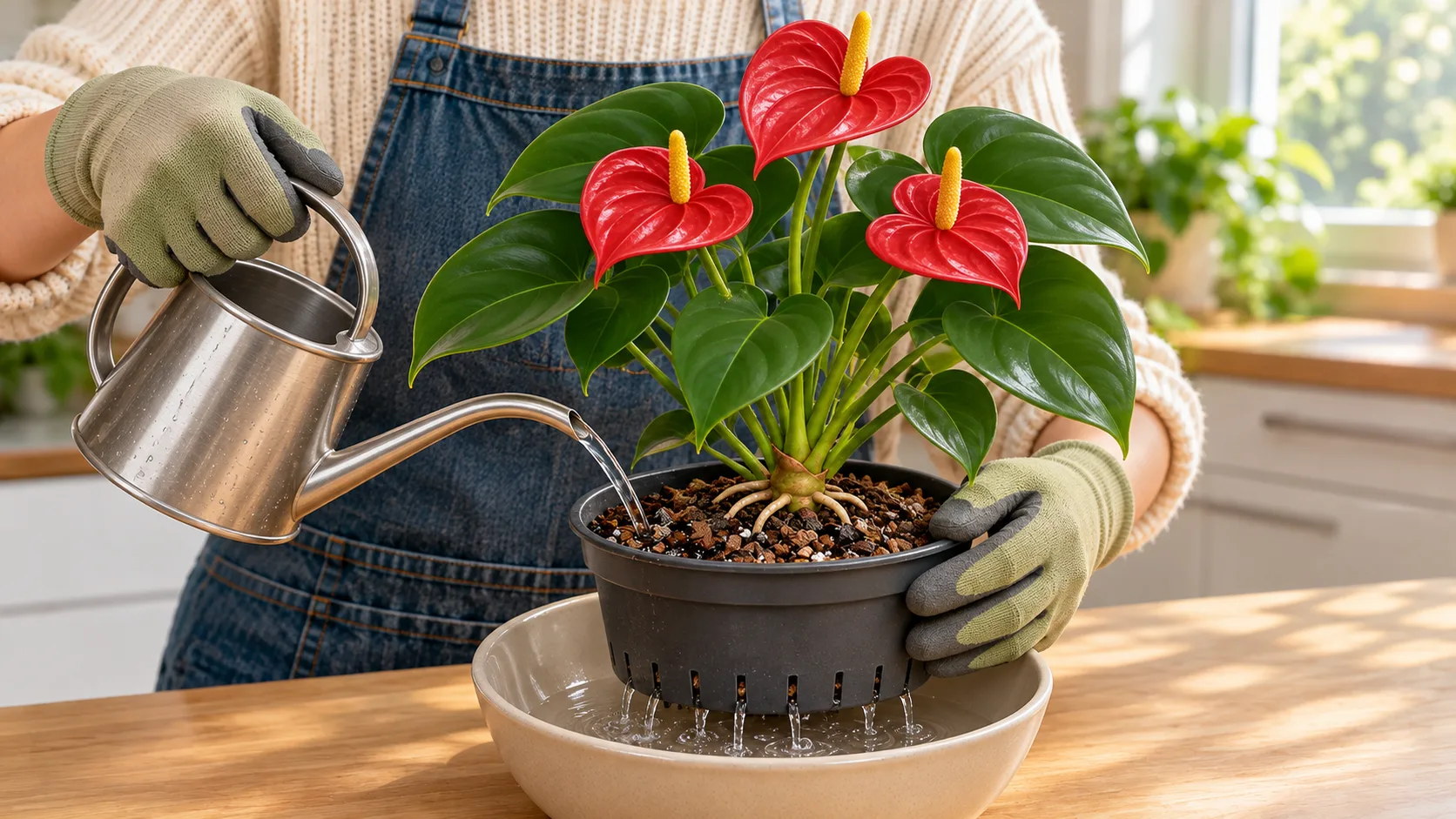
Place your anthurium near an east- or west-facing window; at a south-facing window, use a sheer curtain to filter the sun. Keep the light bright and indirect. 4 A dark position mainly slows flowering, whereas direct sun can scorch the large leaves. 1
For another member of the arum family with a spathe, compare peace lily care: the colour of an inflorescence does not remove the need to match its position to the plant’s requirements.
What humidity does it need?
Relative humidity of 60 to 80% suits Anthurium andraeanum. 1 A hygrometer measures the room’s air; it does not tell you whether the pot needs water. Leaf edges can turn brown in the dry air of a heated home. 4
A humidifier or tray of damp gravel helps improve conditions around the plant. Keep the pot above the water, without standing in it. 3 Humidifying the air does not mean keeping the leaves wet: damp foliage and poor air circulation encourage leaf spots. 1
Which compost should you use, and when should you repot?
Repot in spring, every two to three years or when the roots are crowded, using an acidic, airy, free-draining mix. 1 Anthuriums are often epiphytes. Dense, constantly damp compost is a poor match for that habitat. 4
- Repot
- Every 2 to 3 yearsindoorsSource: NC State Extension Gardener Plant Toolbox
- When to repot
- In springSource: NC State Extension Gardener Plant Toolbox
- The new pot
- 2,5 to 5 cm widerDiameter and depth <25 cm; maximum +1/3 for any potSource: RHS
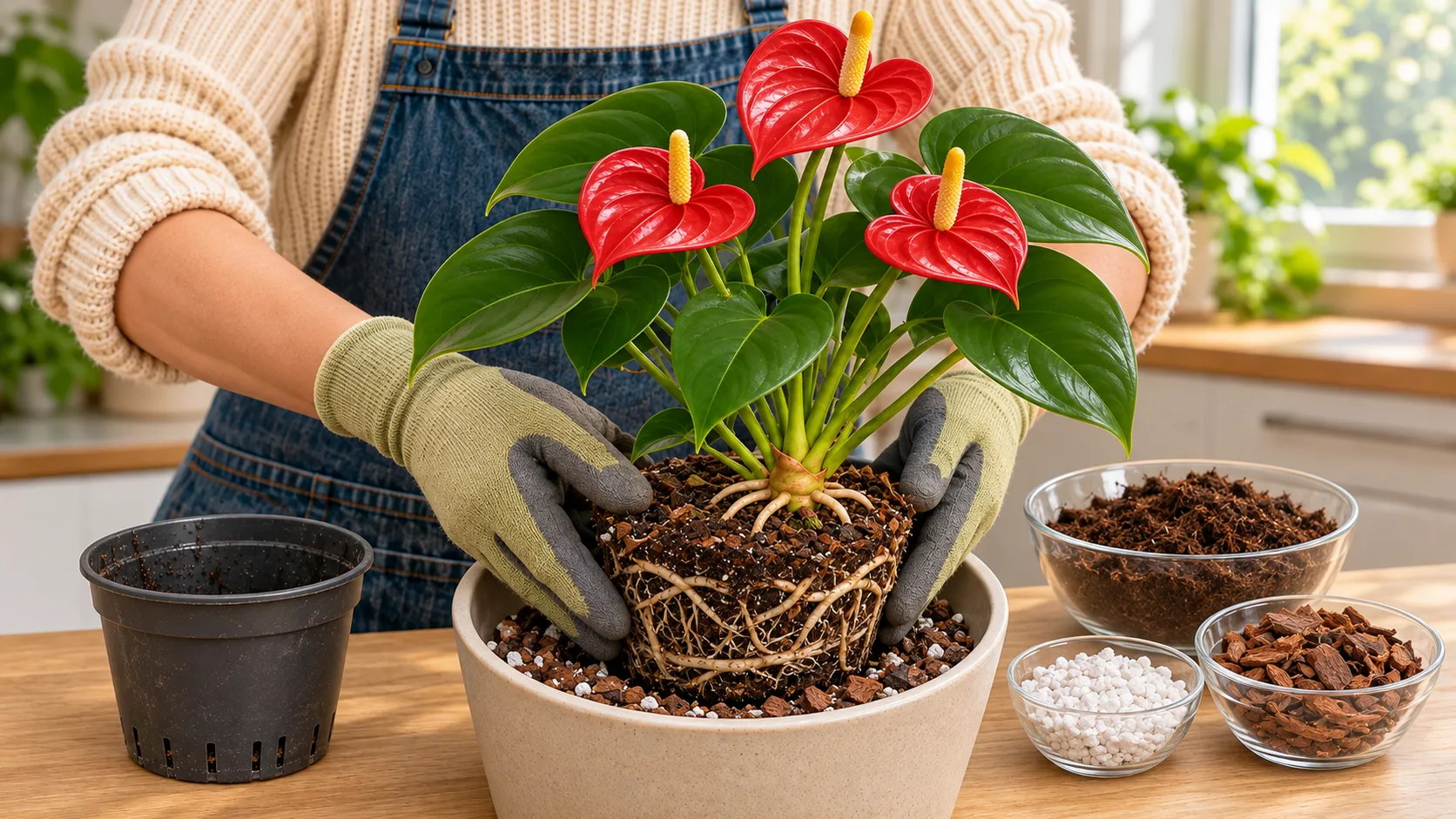
A practical mix uses two parts peat-free ericaceous compost, one part perlite and one part medium orchid bark, measured by volume. 4 The compost holds a reserve of water; the coarse ingredients keep the structure open. Use a pot with drainage holes that accommodates the roots without a large volume of fresh compost around them: an oversized container stays wet too long. 4
Wear gloves when repotting: the sap can irritate skin. 3 Other repotting guides let you compare potting mixes for different plants.
Which fertiliser should you give an anthurium, and how much?
Give orchid fertiliser every two weeks during growth, from April to October. 5 4 Use the dilution stated on your chosen product; concentrations vary between bottles. Feed a plant that is growing, with watering and drainage working properly around its roots.
- Fertilizer
- For orchids, dilutedSource: RHS
- Feeding
- April to OctoberDuring active growth · indoorsSource: RHS
- Frequency
- Every 14 daysAt the dilution stated on the product · indoorsSource: Royal Horticultural Society
- Avoid
- Exceeding the dose on the labelSource: UF/IFAS
Does an anthurium need pruning?
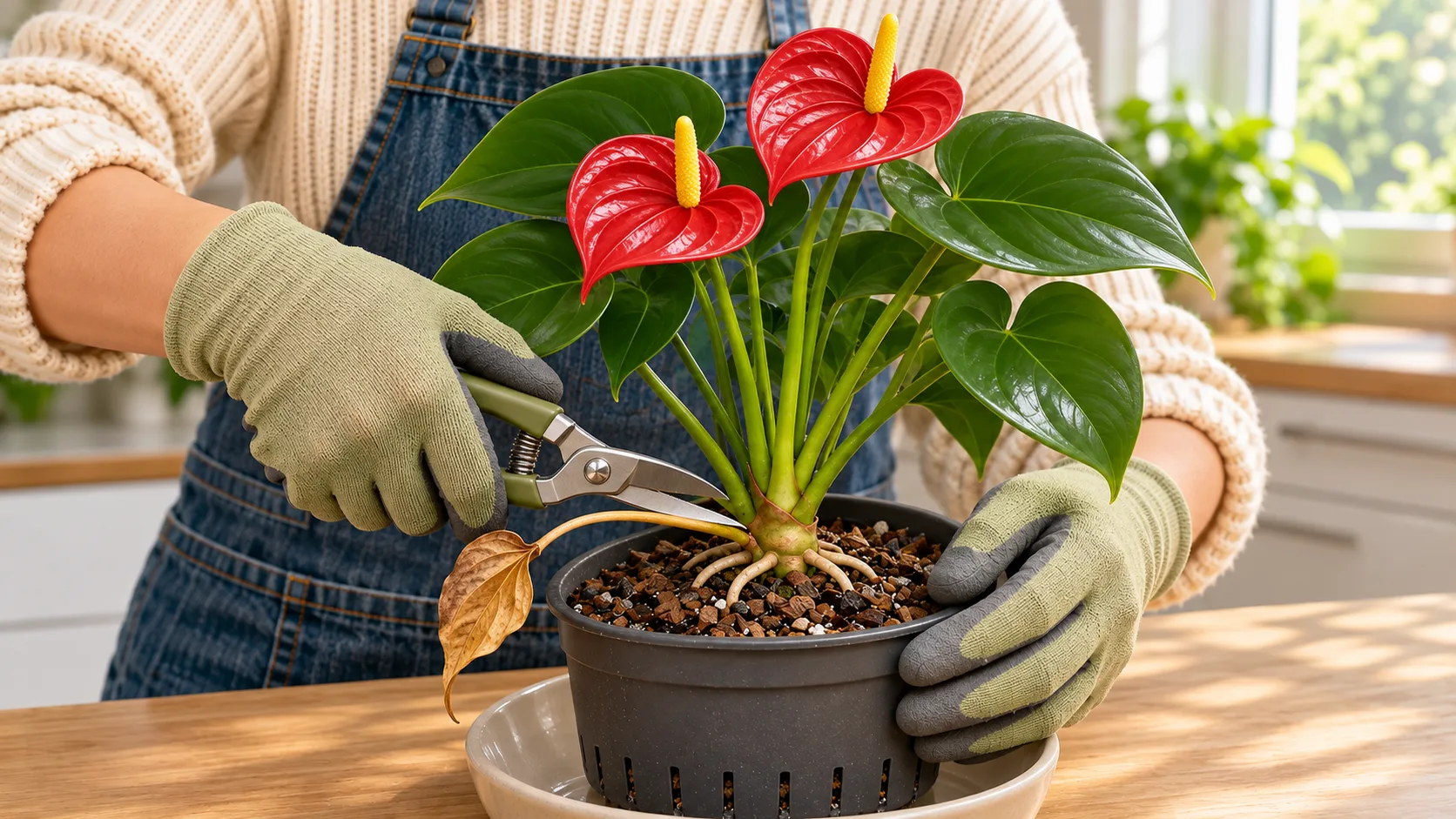
Anthuriums need no formative pruning: remove only dead leaves and spent flower stems, cutting at their base. 4 They are not shrubs to cut back for more flowers. Keep the healthy leaves that feed the clump.
The pruning guides cover techniques for plants that need a real reduction in their branches.
What temperature should you maintain in winter?
Keep anthuriums in a warm room, ideally between 18 and 22 °C (64 to 72 °F), and bring them under cover before temperatures fall below 16 °C (61 °F). 6 In winter, the species’ growing guidance recommends staying above 18 °C (64 °F). 5 A cold garage or a conservatory kept merely frost-free is therefore unsuitable.
- Winter conditions
- Indoors all yearSource: Royal Horticultural Society
- Light
- A bright roomSource: Royal Horticultural Society
- Winter watering
- Water sparinglyWait for the surface of the mix to drySource: Royal Horticultural Society
The protection threshold is not a survival limit: at 10 °C (50 °F) or below, cold can damage or kill anthuriums. 7 Protect the pot on the journey home from the shop too, and avoid contact with cold glass or exposure to draughts. 4
How large does a potted anthurium grow?
A potted Anthurium andraeanum commonly reaches around 30 to 45 cm (12 to 18 in) tall and 23 to 30 cm (9 to 12 in) wide. 1 Habit varies between horticultural selections; ‘Baron’, for example, is described as compact. 1 Choose a plant according to its label and the space available around its leaves.
- Mature height
- 30 to 90 cm
- Spread
- 50 to 90 cm
- Growth
- Moderate to fast in warm, humid conditions
A crowded clump is no reason to cut off all the large leaves to make it smaller. When the roots fill the pot, repotting or division are the appropriate steps. 1 A plant too wide for its position is easier to move than to reshape through severe pruning.
When does an anthurium flower, and how can you get it to flower again?
Anthuriums can flower several times a year; an inflorescence lasts up to four weeks in good conditions. 1 The colourful part is a spathe, surrounding the spadix. 4 Flowering can resume throughout the year, with pauses between flushes. 6
- What triggers flowering
- No trigger: it flowers continuouslySource: Royal Horticultural Society
- Flowering
- At any timeWith sufficient light, warmth and humiditySource: RHS
The month-by-month care calendar
In spring, check room for the roots; from April to October, feed the growing plant; in winter, maintain warmth and water less often. 1 4 These months are a guide for a pot in a mainland French home. How dry the mix actually is takes priority over a fixed routine.
| Task | January | February | March | April | May | June | July | August | September | October | November | December |
|---|---|---|---|---|---|---|---|---|---|---|---|---|
| Watering | reduced | reduced | moderate | moderate | high | high | high | high | high | moderate | reduced | reduced |
| Growth | resting | resting | active | active | active | strong | strong | strong | active | active | resting | resting |
| Feeding | no | no | no | yes | yes | yes | yes | yes | yes | yes | no | no |
| Repotting | no | no | favorable window | favorable window | favorable window | no | no | no | no | no | no | no |
During short days, a pot can remain damp longer, even in a heated room. Test it before each watering, protect it from draughts and continue watching new leaves. When active growth returns, resume feeding and repot if the root ball is crowded. 5 1
How do you propagate an anthurium?
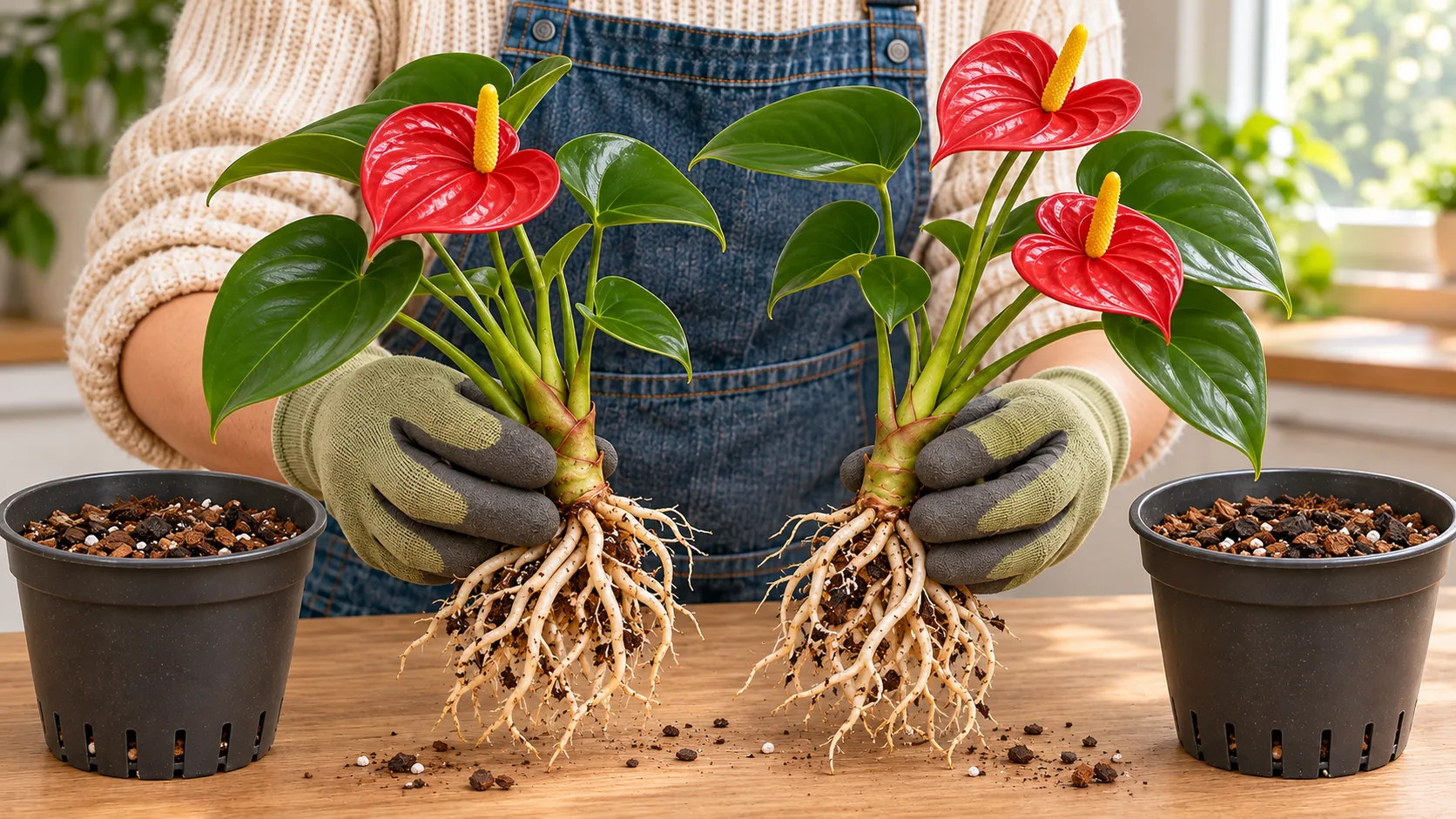
Divide a clump with several growing points in spring or summer, keeping roots on each section. 5 4 This gives you established sections, each with its own growing point. Prepare pots sized to fit the roots, then plant the divisions separately in an airy mix. 3
- Stem segment cutting
- In springSource: Royal Horticultural Society
- Stem segment cutting
- In summerSource: Royal Horticultural Society
- Division
- In springSource: Royal Horticultural Society
- Division
- In summerSource: Royal Horticultural Society
Choose propagation techniques according to the parts each plant produces.
Common problems: diagnosis
Before treating a yellow or brown leaf, check the compost, roots and leaf undersides. Incorrect watering, sun scorch, fertiliser salts and pests can produce similar symptoms. 2 1
Anthurium: signs to compare before choosing a treatment.
| Visible sign | Cause to check | First step |
|---|---|---|
| Yellow lower leaves and a root ball that stays wet | Overwatering, damaged roots | Check the roots and let the surface dry more thoroughly 2 |
| Brown tips after repeated feeding | Fertiliser salt accumulation | Reduce feeding and flush the mix, allowing water to drain away 2 |
| A large dry patch on an exposed leaf | Sun scorch | Filter direct sunlight 2 |
| White clusters in crevices | Mealybugs | Isolate the pot and inspect other plants 8 |
| Pale stippling, small webs beneath leaves | Spider mites | Inspect the undersides and move the plant away from its neighbours 9 |
| A wet patch at the edge spreading in a V shape | Possible Xanthomonas bacterial blight | Isolate, keep leaves dry and seek confirmation 10 |
Anthurium infections can affect leaves, roots or the spadix. Colour alone cannot identify the cause; bacterial diseases and rots require different hygiene measures from a watering problem. 10
To distinguish rotten roots, bacterial spots and pests: anthurium diseases can be recognised by comparing the shape and spread of the lesions.
| What you see | Likely cause | What to do |
|---|---|---|
| Soil stays soggy, suffocating roots and causing rot. | OverwateringExternal Factors | Treating Waterlogged Soil |
| The plant wilts and yellows while the soil stays wet. | Root RotDiseases | Treating Waterlogged Soil |
| The soil is dry and leaves are soft and drooping. | UnderwateringExternal Factors | Rescue by Soaking |
| Tiny arachnids that spin fine webs under leaves. | Spider MitesPests | Eliminate Spider Mites |
| White cottony clumps in leaf axils and on stems. | MealybugsPests | Eliminate Armored Scale Insects |
| Oily, angular spots confined by leaf veins. | Bacterial Angular Leaf SpotDiseases | Stop Bacterial Leaf Spot |
| Brown leaf tips and a white crust on the soil. | Salt BuildupExternal Factors | Flushing Soil Salts |
Is anthurium poisonous?
Yes: oxalate crystals irritate the mouth, skin and mucous membranes. 11 Keep the plant away from children, cats and dogs. If swallowed, call a poison centre or a vet; do not induce vomiting. 12 13 The risks are detailed in the anthurium botanical profile.
Which anthurium variety should you choose?
Choose a variety for its habit and spathe; ‘Baron’ suits limited space thanks to its compact growth. 1 Colour alone does not change the compost test or the need for bright, filtered light.
Andraeanum Group
Horticultural name
Horticultural group used for cut-flower and pot-plant forms and hybrids.
Acropolis
Stable cultivar
Horticultural cultivar listed by NC State; check the full label when buying.
Baron
Stable cultivar
Cultivar listed in horticultural references; distinguish its status from the species name.
Cheers
Stable cultivar
Cultivar or commercial series name associated with colourful spathes.
Florida
Stable cultivar
Trade name listed for florist’s anthurium.
Midori
Stable cultivar
Cultivar associated with green spathes in horticultural lists.
1 more varieties documented in the botanical profile.
Anthurium andraeanum varieties: visible features to help you choose a potted plant. 1
| Cultivar | Spathe and spadix | Distinctive feature |
|---|---|---|
| 'Acropolis' | Large glossy white spathe; cream spadix, pale yellow at the tip | White-and-green contrast |
| 'Baron' | Pink centre and green edges | Compact habit, glossy green leaves |
| 'Cheers' | Pink spathe | Pink colouring |
| 'Florida' | Bright red spathe; spadix turning yellow | Dark green foliage |
| 'Midori' | Green spathe | Decorative green, distinct from a change on another variety |
| 'Rosee Choco' | Deep red spathe | Dark colouring |
Frequently asked questions
Clean the leaves to remove dust, and look for insects if a sticky deposit returns. 3 8
How do you clean anthurium leaves?
How long does an anthurium usually live?
A potted anthurium can keep flowering over many years when growing conditions suit it. A pause between flowering periods therefore does not mean the plant has reached the end of its life: check the health of new leaves and roots before replacing it. 6
Why are my anthurium’s leaves sticky?
Look for mealybugs or other sap-feeding insects: their honeydew, a sugary liquid, sticks to leaves and can support black sooty mould. White waxy clusters in crevices suggest mealybugs. Isolate the pot and inspect neighbouring plants before cleaning off the deposit. 8