
Care guide
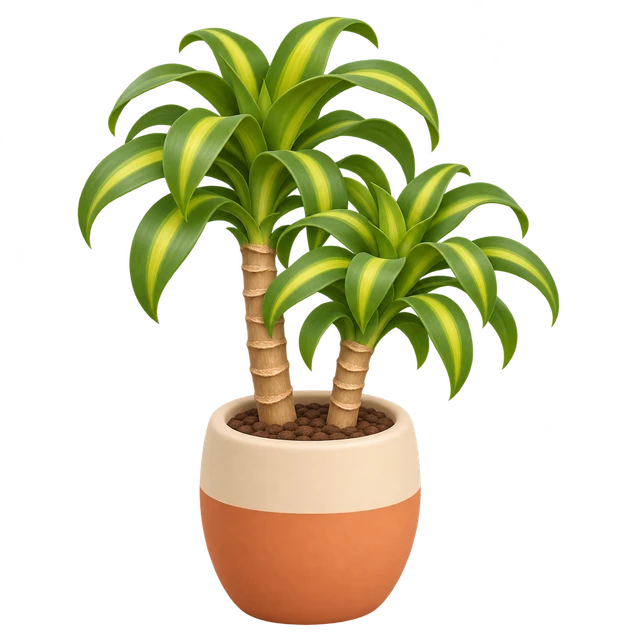
Corn plant care
Dracaena fragrans
Corn plant likes a bright room without scorching sun. Wait until the top 5 cm (2 in) of compost is dry before watering, then empty the saucer. Keep it warm: brown leaf tips do not always mean it needs water.
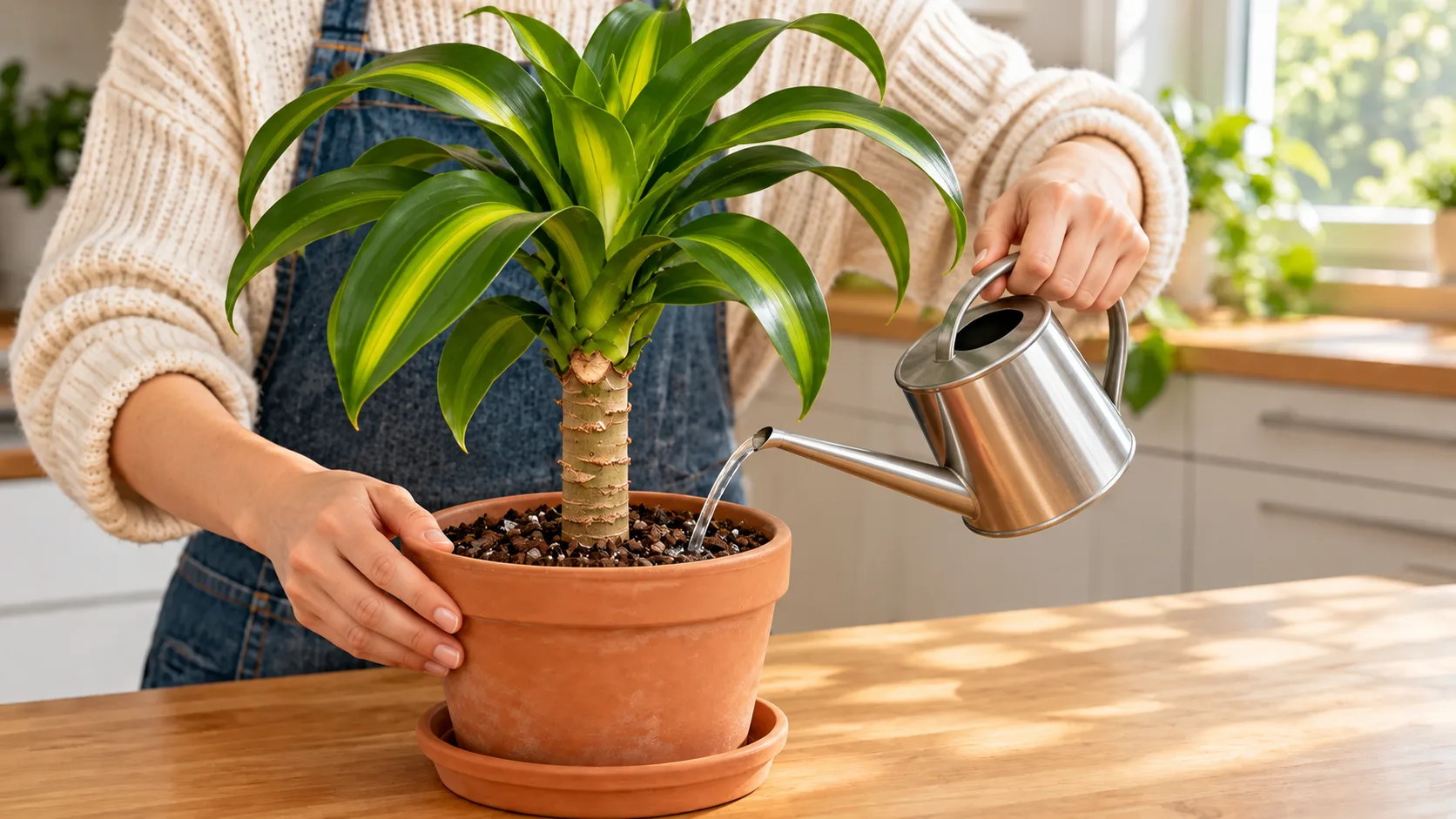
How often should you water a corn plant?
Wait until the top 5 cm (2 in) of compost is dry, then water until it drains through. Empty the saucer after 15 minutes; a still-moist root ball can wait, even in summer. 1 2
17 cL every 16 days
After the top 5 centimetres have dried
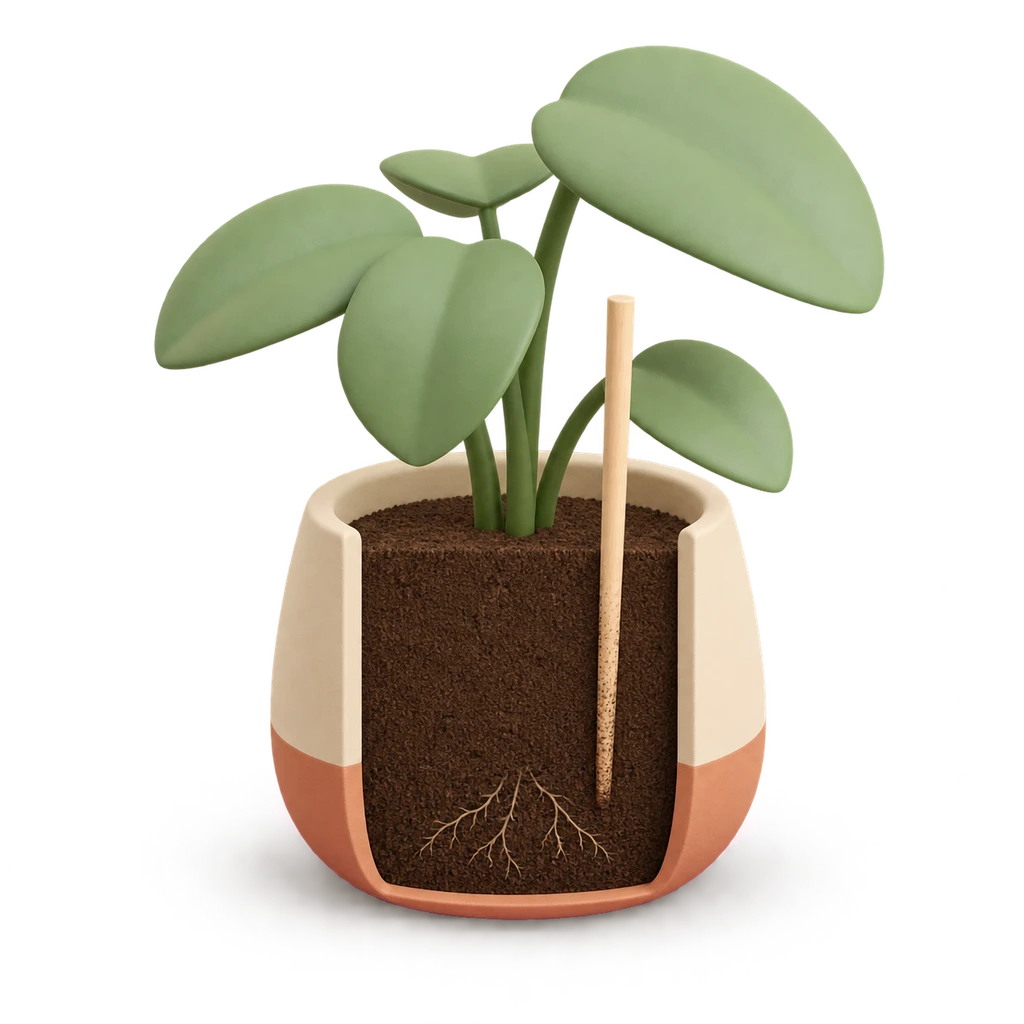
Potting mix dry to 2,5 cm: still moist
The finger test
Push a finger or wooden skewer 5 cm into the potting mix: if it is dry, water; if it is still moist, wait. The condition of the mix decides, not the calendar.
Where should you put a corn plant?
Keep the plant in bright, filtered light near an east- or west-facing window. At a south-facing window, screen hot rays with a sheer curtain; all the rosettes need light. 1 2
What humidity keeps the leaves healthy?
Aim for air humidity above 40%, especially when the heating is on. Overly dry air can brown the tips even when the roots have enough water. A small hygrometer near the foliage helps distinguish dry air from dry compost. 2
Move the pot away from radiators and air vents. If the air stays dry, a humidifier is more effective than occasional misting. You can also group plants or put the pot on a tray of damp pebbles, keeping its base above the water. 1 3
Misting raises humidity only briefly and cannot replace these measures. It can also encourage diseases to spread when foliage stays wet. Improve the room’s air without automatically increasing watering. 3 4
Which compost should you choose, and when should you repot?
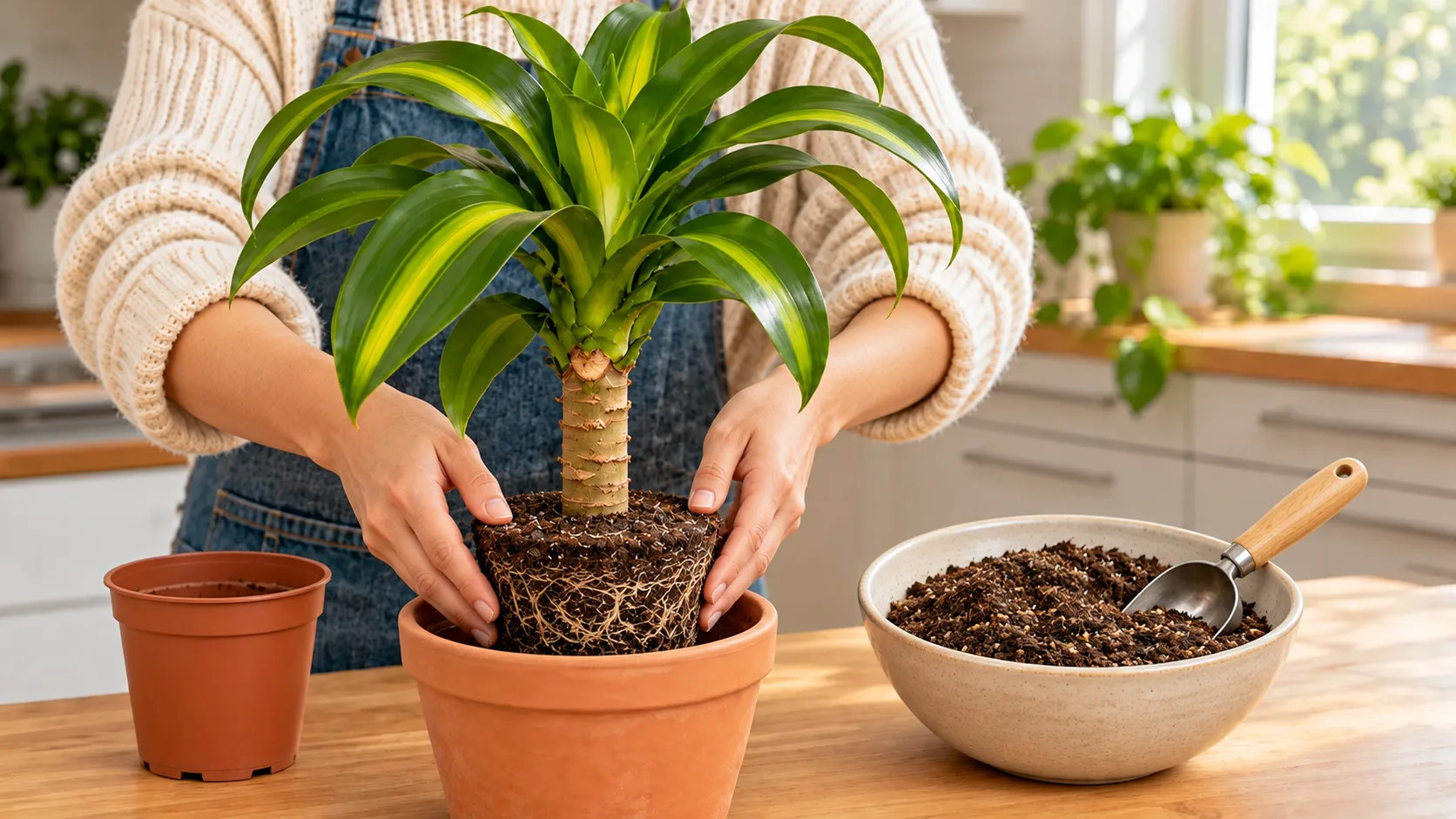
Repot in spring if roots fill the pot, emerge through its holes or lift the plant. Choose the next pot size and an open mix: a large volume of wet compost increases the risk of rot. 1 5
The container needs drainage holes, enough stability for the canes and access for emptying water. A decorative outer pot is possible if the inner pot can be lifted out and allowed to drain completely. 2 3
Which fertiliser should you use, and how much?
During active growth, apply a balanced liquid fertiliser once a month. Do not force a slow-growing plant with a more concentrated solution; excess fertiliser can damage its roots. 6 1
- Fertilizer
- BalancedLiquidSource: Royal Horticultural Society
- Feeding
- In springOnly if the plant is growingSource: Clemson Cooperative Extension
- Feeding
- In summerOnly if the plant is growingSource: Clemson Cooperative Extension
- No fertilizer
- During dormancyStop if growth ceasesSource: Iowa State University Extension
- Frequency
- One application per monthindoorsSource: Clemson Cooperative Extension
- Avoid
- Exceeding the dose on the label, feeding immediately after repottingSources: Clemson Cooperative Extension; Iowa State University Extension
When and how should you prune a corn plant?
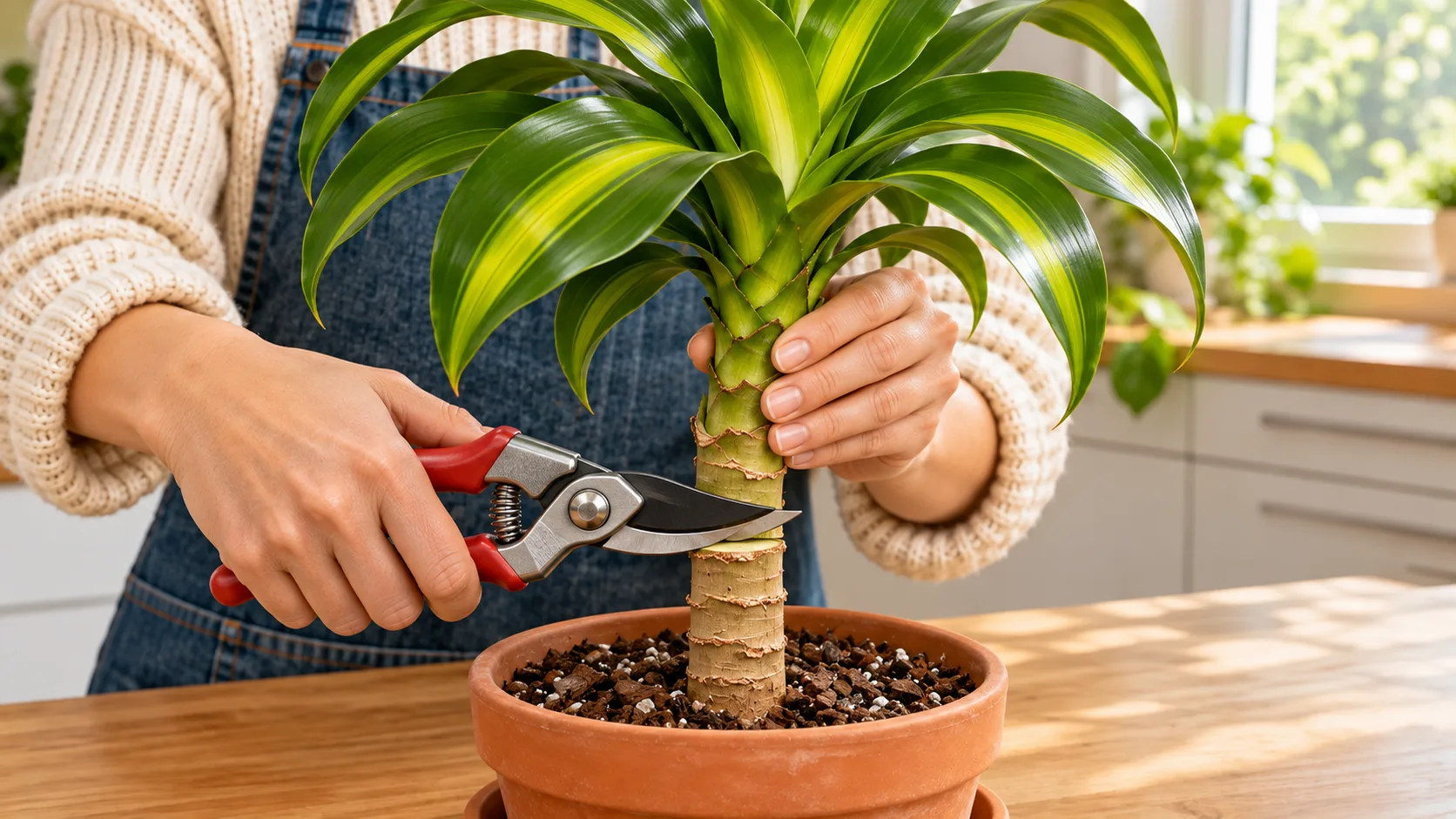
Routine pruning is unnecessary. In spring, a weak or excessively tall cane can be shortened; cut just above a node so new shoots can develop near the cut. 6 2
The plant pruning guides bring together techniques for individual species.
What temperatures can a corn plant tolerate?
Keep it in a warm, stable room, away from radiators and draughts. If it spends summer outdoors, bring it in before nights fall below 10 °C (50 °F); in winter, space out watering without drying the whole root ball. 5 1 2
Temperatures for corn plant
In °C, thresholds given by the sources.
- Bring indoors before cool nights10 °C
- Ideal: 21 to 27 °C
- Favourable growth range: 21 to 27 °C
- Winter conditions
- Indoors all yearSource: Royal Horticultural Society
- Light
- A bright roomSource: RHS
- Winter watering
- Water less often according to compost dryingWithout drying out the whole root ballSource: New York Botanical Garden
How large does it grow indoors?
Allow space for the cultivar, and use spring pruning to control an overly tall cane. In sheltered cultivation, corn plant reaches 1.5 to 2.5 m (5 to 8 ft) tall and 0.1 to 0.5 m (4 to 20 in) wide, with variation between cultivars. 6 ‘Lemon Lime’ can reach 1 to 1.5 m (3 to 5 ft) tall and 0.5 to 1 m (20 in to 3 ft) wide; ‘Massangeana’ 2.5 to 4 m (8 to 13 ft) by 1 to 1.5 m (3 to 5 ft) over time in sheltered cultivation. ‘Massangeana’ takes 10 to 20 years to reach maturity. 7 8
- Mature height
- 1,5 to 2,5 m
- Spread
- 10 to 50 cm
- Growth
- Slow
Growth is slow, but a plant kept for a long time may eventually outgrow its space. ‘Compacta’ has tight rosettes on slow-growing stems; a large plant can be shortened rather than put in a dark corner to hold it back. 5 9
What about the scented flowers?
A mature plant can produce a stem of strongly scented flowers, especially fragrant in the evening and at night. Flowering remains occasional indoors; foliage is the corn plant’s main attraction. Maintain the same good light, warmth and drainage without overdosing fertiliser to force flowers. 10 5 1
The month-by-month care calendar
Use spring for repotting, pruning or taking cuttings, and let the pot’s drying rate guide watering throughout the year. 1 2 As spring growth resumes, inspect roots, repot if needed, shorten an overly tall cane or take a cutting. Fertiliser supports new leaves; it cannot replace better light or healthy roots. 1 8 2
| Task | January | February | March | April | May | June | July | August | September | October | November | December |
|---|---|---|---|---|---|---|---|---|---|---|---|---|
| Watering | reduced | reduced | reduced | moderate | high | high | high | high | high | moderate | reduced | reduced |
| Growth | resting | resting | active | active | active | active | active | active | active | resting | resting | resting |
| Feeding | no | no | yes | yes | yes | yes | yes | yes | yes | no | no | no |
| Repotting | no | no | favorable window | favorable window | favorable window | no | no | no | no | no | no | no |
In summer, watch how the pot dries and for sun reaching foliage through the glass. In autumn, reduce water as the pot dries more slowly. In winter, keep the room bright, watch for dry air and water less often. 1 5 2
How do you propagate a corn plant?
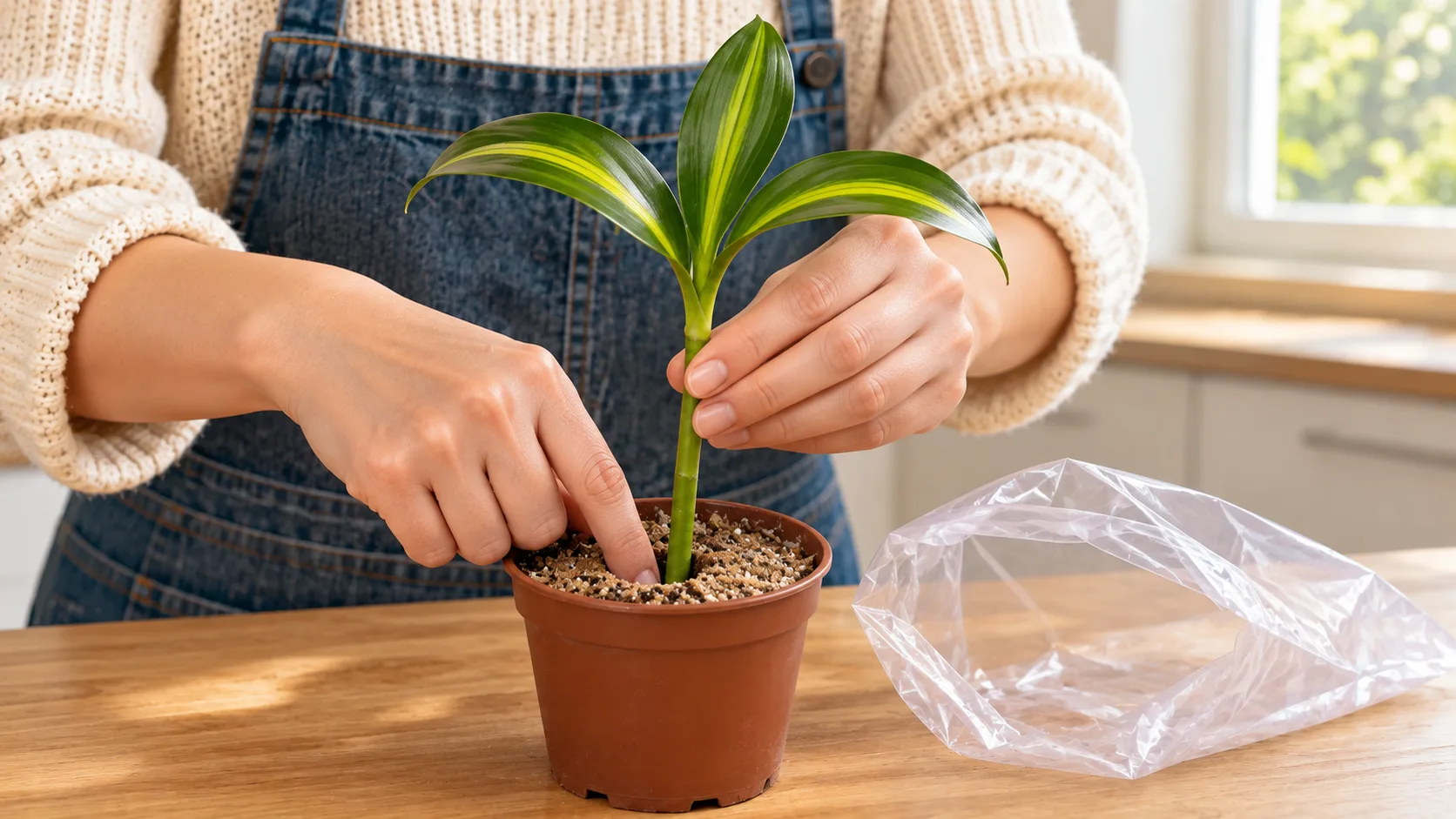
In spring, take a healthy, still-green tip cutting 8 to 15 cm (3 to 6 in) long. Keep it warm in subdued light and a slightly moist mix; rooting generally takes 4 to 6 weeks in this method. 2
- Softwood cutting
- In springHealthy tip cutting · roots in 4 to 6 weeksSource: New York Botanical Garden
- Semi-ripe cutting
- In summerWith bottom heatSource: RHS
- Stem segment cutting
- In springCane bearing a bud · Less reliable establishment than a leafy tipSource: New York Botanical Garden
The plant propagation guides explain methods for individual species.
Common problems: diagnosis
Inspect the compost, roots and leaf undersides before treating. Possible Phoma draconis leaf spot, scale insects, mites and sun scorch need different responses. 4 1 2
Slow loss of old lower leaves is normal. Widespread yellowing with drooping leaves and a damp root ball instead calls for checking roots and standing water. 2
| Observed sign | Cause to check | First step |
|---|---|---|
| Yellow, drooping leaves, damp compost and soft roots | Overwatering and root rot | Empty the outer pot, check drainage and remove rotten roots when repotting. See overwatering. 2 11 |
| Brown tips and edges, with no visible insects | Dry air, draughts, fluoride or fertiliser salts | Check humidity and water quality before watering more; reduce feeding if excessive. 2 5 |
| Pale, dry patches on the window side | Sun scorch | Filter the rays or move the plant back. Protect all foliage exposed to the glass. 2 |
| White cottony clusters in leaf axils, sticky foliage | Mealybugs | Inspect leaf sheaths and neighbouring plants; follow the mealybug guidance. 12 |
| Fine pale stippling, tiny mites and sometimes webs | Red spider mites | Examine undersides and move away from dry heat; humidity alone cannot control an attack. See spider mites. 13 |
| Small fixed shields on leaves or stems | Scale insects | Check stems and undersides; consult the scale insect guide. 9 |
| Irregular yellow spots turning brown with a purple margin | Possible Phoma draconis leaf spot | Remove affected leaves and water the compost without wetting foliage. Precise identification requires examining spots and their development. 4 |
| What you see | Likely cause | What to do |
|---|---|---|
| Soil stays soggy, suffocating roots and causing rot. | OverwateringExternal Factors | Treating Waterlogged Soil |
| The plant wilts and yellows while the soil stays wet. | Root RotDiseases | Treating Waterlogged Soil |
| Tiny arachnids that spin fine webs under leaves. | Spider MitesPests | Eliminate Spider Mites |
| White cottony clumps in leaf axils and on stems. | MealybugsPests | Eliminate Armored Scale Insects |
| The plant stretches, turns pale, and leans toward the window. | Low LightExternal Factors | Increase light |
Is corn plant poisonous?
Saponins make corn plant toxic to cats, dogs and horses. Keep the whole plant out of reach. After animal ingestion, contact a vet; for a person in France, call a poison centre (ORFILA : 01 45 42 59 59) without waiting for symptoms. 14 1 15 16
Which corn plant variety should you choose?
Choose a compact habit for a small space; allow for the spread of ‘Massangeana’ if you want a large arching cane. ‘Compacta’ bears short, closely packed leaves. Variegation distinguishes the striped forms. 9
Massangeana
Stable cultivar
Broad yellow central stripe, also sold as Mass Cane or corn plant.
Compacta
Stable cultivar
Compact habit with smaller, flat, pointed leaves, suited to small spaces.
Warneckei
Stable cultivar
White-striped leaves, sold under the synonym Dracaena deremensis; RHS Award of Garden Merit.
Lemon Lime
Stable cultivar
Vivid yellow-green stripes; Royal Horticultural Society Award of Garden Merit.
Janet Craig
Stable cultivar
Plain dark green foliage without variegation; one of the most widely sold indoor cultivars.
Lindenii
Horticultural name
Leaves with cream-white marginal stripes; historical name found in Tropicos catalogues.
1 more varieties documented in the botanical profile.
Dracaena fragrans varieties: useful differences when choosing a houseplant.
| Variety | Distinctive feature | What to allow for at home |
|---|---|---|
| ‘Massangeana’ | Broad yellow central stripe on arching green leaves | Allow height and width over time; can be shortened in spring. 8 |
| ‘Compacta’ | Short, densely packed leaves on slow-growing stems | Suits a compact outline; keep in a bright place. 9 |
| ‘Warneckei’ | Grey-green leaves with fine white margins, up to 60 cm (24 in) long | Tolerates lower light; scorching sun still needs filtering. 17 9 1 |
| ‘Lemon Lime’ | Green and vivid yellow-green stripes; upright then branching | Mature height of 1 to 1.5 m (3 to 5 ft) helps plan its position. 7 |
| ‘Janet Craig’ | Plain green, glossy, grooved leaves, 25 to 50 cm (10 to 20 in) long | For foliage without pale stripes; distinguish from ‘Janet Craig Compacta’. 18 |
| ‘Lindenii’ | Pale side stripes, cream to yellow-green depending on clone | Variegation may fade with age or insufficient light. 9 18 |
| ‘Victoria’ | Brighter yellow stripes than ‘Lindenii’ | Choose a labelled plant, looking at the actual leaf pattern. 18 |
Snake plant also belongs to Dracaena, but its succulent leaves need different care: do not apply its dry regime to a corn plant cane. 2 These cultivars belong to the same tropical African species. For older names such as Dracaena deremensis, botanical features and confusion with other plants, see the corn plant profile. 19 18
Frequently asked questions
Before cutting a leaf or moving the pot, note which leaves are changing and whether the compost stays wet.
Why are my Dracaena’s leaves falling off?
After purchase or a change of room, leaf loss can accompany adjustment to a different temperature. Keep the position stable and away from draughts. Slow loss of only the lowest leaves is also part of normal ageing; sudden, widespread leaf fall calls for checking for stress. 2
Should you cut brown leaf tips off a Dracaena?
How long does a Dracaena live?
Dracaena can live indoors for a long time: it is a slow-growing perennial. Its trunk gradually becomes bare while the rosette continues producing leaves. A cane that has become too tall can be shortened and grow another leafy top; this change does not mean the plant is reaching the end of its life. 1 5 2