
Care guide
Rubber plant care
Ficus elastica
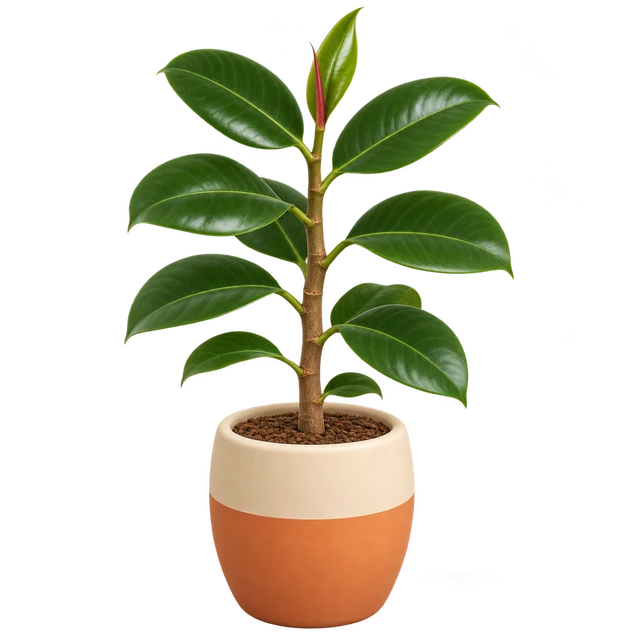
Rubber plant keeps its foliage healthy near a bright window, in a pot with drainage holes whose compost dries slightly between waterings. Stable conditions suit it: avoid cold draughts and repeated moves. Wear gloves when pruning to protect yourself from irritating latex.
How often should you water a rubber plant?
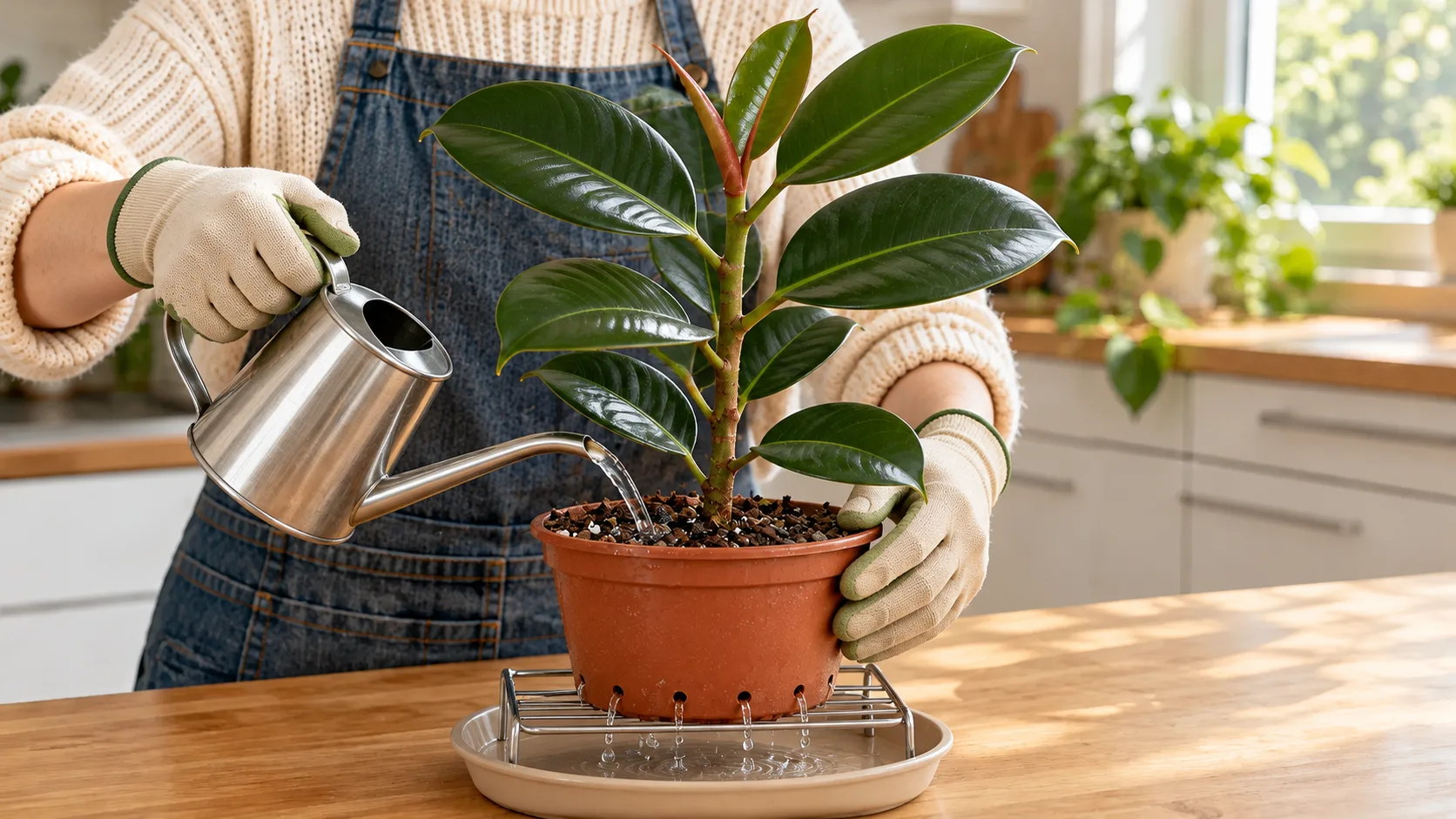
Water when the compost has dried slightly, then let the pot drain and empty the saucer. Feeling the mix and checking the container’s weight are more useful than a fixed day. Reduce watering in winter: constantly wet compost encourages yellowing and root problems. 1 2
17 cL every 11 days
Let dry slightly between waterings
Water sparingly
Where should you put a rubber plant?
Choose bright, filtered or indirect light. Gentle morning sun suits the plant; protect leaves from strong afternoon sun. Variegated forms need more light. Then keep the position stable and free from cold draughts. 3 1 4
What air humidity suits it?
It enjoys moderately humid air, but rubber plant tolerates the ordinary dry air of a home. Dry, shrivelled leaves call for checking room humidity, compost dryness and sun exposure together; they do not identify a single cause on their own. 1 3
To increase humidity around the pot, put it on a tray of damp gravel with water below the gravel surface. Keep the container above the water. This arrangement humidifies the plant’s surroundings while maintaining drainage; you still need to check the root ball. 3
Foliage can be misted in hot weather. Keep the distinction between air humidity and watering roots: already damp compost does not need more water because the air seems dry. 3 2
Which compost should you choose, and when should you repot?
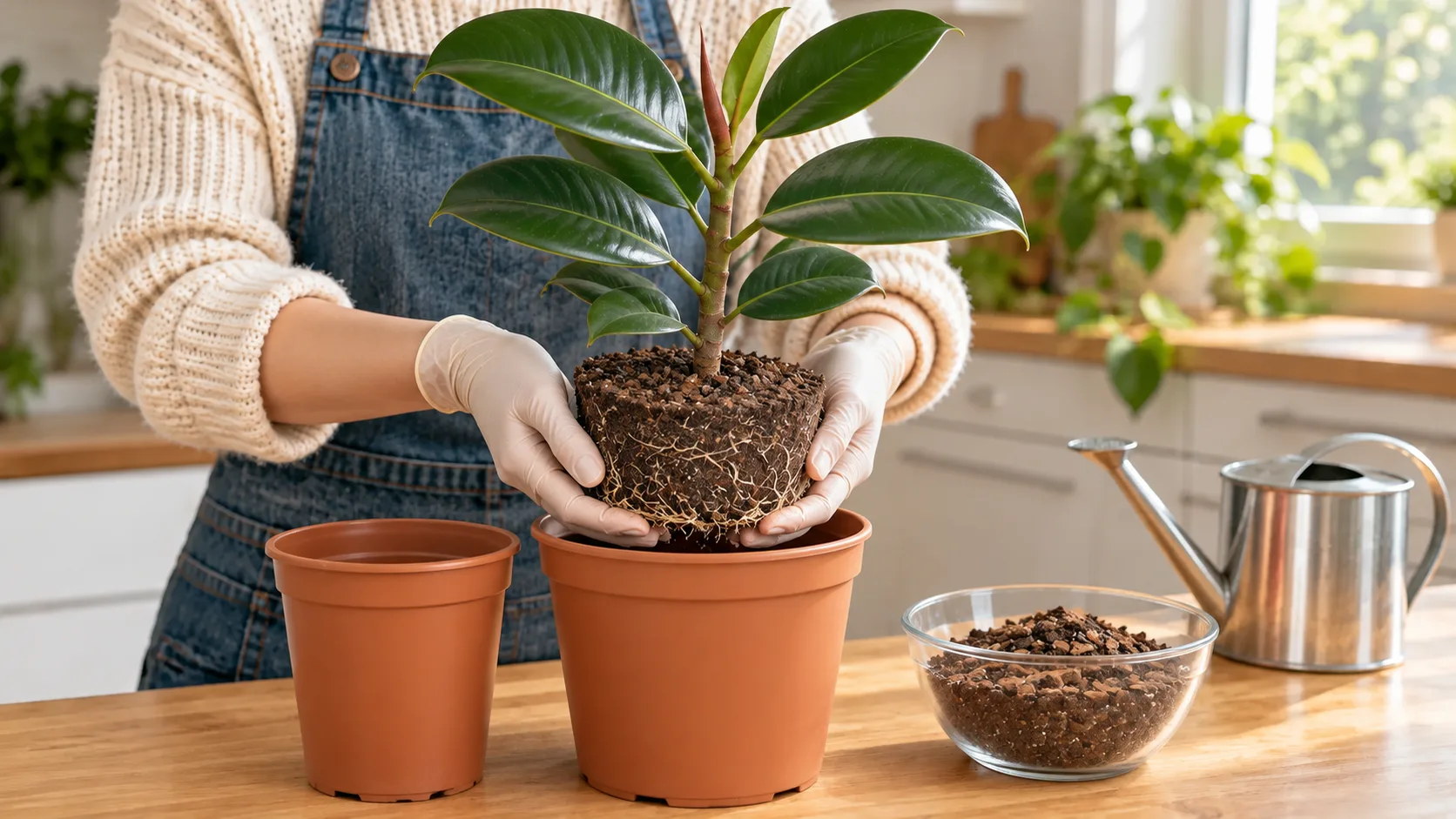
Repot in spring, usually every two to three years, into a slightly larger container. Choose a free-draining mix and do not bury the trunk. For an old pot less than 25 cm (10 in) in both diameter and depth, the general guideline is about 2.5 to 5 cm (1 to 2 in) wider and deeper. In years without repotting, replace the top 2.5 cm (1 in) of compost. 5 3 6
- Repot
- Every 2 to 3 yearsindoorsSource: Royal Horticultural Society
- When to repot
- In springSource: Royal Horticultural Society
- Refresh the top layer
- In springin years without repottingSource: Royal Horticultural Society
- The new pot
- 2,5 to 5 cm widerold pot less than 25 cm in diameter and depthSource: Royal Horticultural Society
How should you keep a rubber plant in a pot?
A pot with drainage holes must allow excess water to be collected and removed. Porous terracotta generally dries faster than plastic, so check watering needs after a change of container. Plan for the weight of a large plant and access to its root ball too. 2 4
Which fertiliser should you give a rubber plant?
During active growth, apply a high-nitrogen fertiliser once a month, following the RHS guideline for this species. Follow the product’s dilution instructions and apply to already-moist compost. When light and growth decline, reduce or stop feeding rather than trying to force new leaves. 5 7
- Fertilizer
- High in nitrogenLiquidSource: Royal Horticultural Society
- Feeding
- In springSource: Royal Horticultural Society
- Feeding
- In summerSource: Royal Horticultural Society
- No fertilizer
- In winterwhen growth slowsSource: University of Connecticut
- Frequency
- Once a month during growthindoorsSource: Royal Horticultural Society
- Avoid
- Applying fertilizer to a dry root ball, exceeding the dose on the label, feeding during dormancySource: University of Connecticut
When and how should you prune a rubber plant?
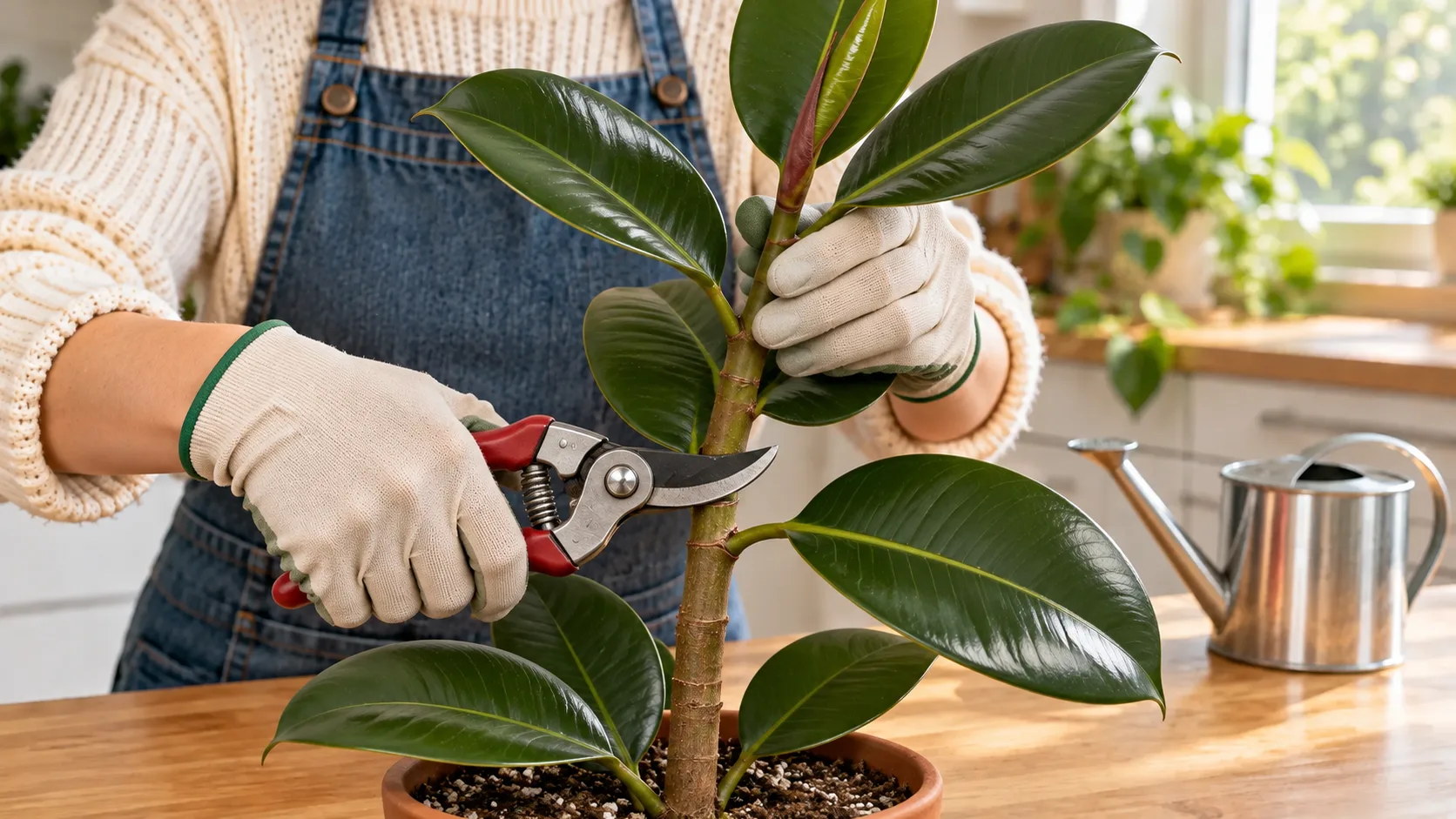
A rubber plant does not need annual pruning. If it grows too large, shorten overlong shoots in late winter or early spring, just above a leaf. Remove wholly green shoots appearing on a variegated cultivar, and wear gloves against the latex. 3
The plant pruning guides bring together techniques for individual species.
When should you support a rubber plant’s stem?
A tall, sparsely furnished plant can be supported with a stake if you want to retain its height. Support does not correct insufficient light; reducing height instead calls for pruning. 1
What minimum temperature can it tolerate?
Keep rubber plant above about 13 °C (55 °F) and avoid sudden temperature drops. This growing guideline protects a tropical plant; a cool night and a persistently cold room need a different response from a heated living room. 1 4
Temperatures for rubber plant
In °C, thresholds given by the sources.
- Recommended growing minimum13 °C
- Ideal: 18 to 27 °C
- Comfort range for indoor figs: 18 to 27 °C
- Light
- A bright roomSource: Royal Horticultural Society
- Winter watering
- Keep the compost just moistSource: Royal Horticultural Society
Its hardiness is low. The H1b rating allows outdoor cultivation in summer, followed by a return under cover. Indoors, around 18 to 27 °C (64 to 81 °F) without draughts suits ornamental figs. 5 8
In mainland France, decide on a summer outdoor stay according to night-time minima, with filtered light. Bring the pot indoors before cool nights, into a bright space. To protect the plant when airing a room in winter, choose a position outside the path of cold air from the start. 5 4
How should you overwinter it indoors?
Keep a bright, stable position away from cold draughts. Reduce watering to keep the compost just moist; leaf drop calls for checking water, light and chilling before changing several aspects of care. 3 4
How tall does a potted rubber plant grow?
Allow around 1.8 to 3 m (6 to 10 ft) in height in a sufficiently spacious interior; pruning can control growth. These dimensions apply to a plant with room to grow, not an inevitable height for every garden-centre purchase. 1
- Mature height
- 2,5 to 4 m
- Spread
- 1 to 1,5 m
- Growth
- Vigorous in warm, bright conditions
A rubber plant can become heavy. A stake helps a tall, leggy plant; spring pruning lets you reshape it. Space requirements also depend on cultivar: ‘Melany’ has smaller, denser foliage, while ‘Robusta’ develops very large leaves. 1 4 9
Before choosing a large specimen, reserve a bright position where the pot and leaves can stay without repeated moves. Height alone does not determine its wellbeing: a tree kept short through pruning still needs light and drainage. 4 1
What does its flowering look like?
The flowers are hidden in small figs in the leaf axils. Flowering is reported throughout the year in a suitable warm climate, but remains rare indoors; a red tip around a new leaf is a stipule, not a flower. 10 11 4
The month-by-month care calendar
Concentrate repotting and pruning around spring growth; monitor watering more closely during growth, then reduce water and fertiliser as light falls. The routine depends on room warmth and the plant’s actual activity. 3 1 7
| Task | January | February | March | April | May | June | July | August | September | October | November | December |
|---|---|---|---|---|---|---|---|---|---|---|---|---|
| Watering | reduced | reduced | moderate | moderate | high | high | high | high | moderate | moderate | reduced | reduced |
| Growth | resting | resting | active | active | strong | strong | strong | strong | active | active | resting | resting |
| Feeding | no | no | no | yes | yes | yes | yes | yes | yes | no | no | no |
| Repotting | no | no | favorable window | favorable window | favorable window | no | no | no | favorable window | no | no | no |
In a French home, monthly guidelines help plan tasks: inspect the pot at winter’s end, support new leaves during the growing season, then allow the root ball to dry more slowly in winter. Repot in response to crowded roots; water in response to compost condition. 6 2
How do you propagate a rubber plant?
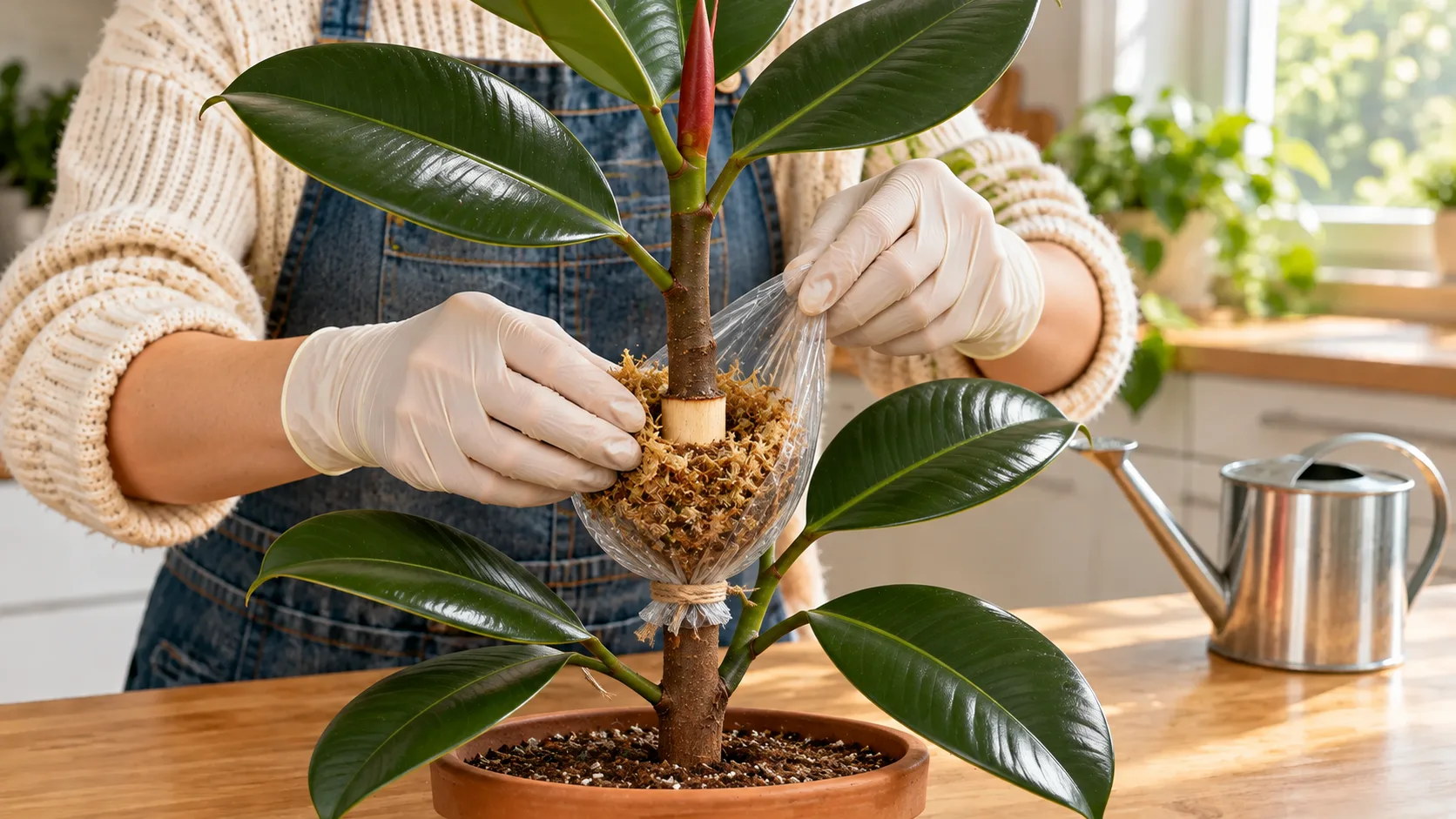
Rubber plant can be propagated from stem cuttings or by air layering. Air layering keeps the stem connected to the parent while roots develop in damp sphagnum moss. Wait for a good root system before separating: the first visible roots and a plant able to live independently are not the same stage. 1 12
- Semi-ripe cutting
- In springSource: Royal Horticultural Society
- Semi-ripe cutting
- In late summerSource: Royal Horticultural Society
- Air layering
- In springSource: Royal Horticultural Society
- Air layering
- In late summerSource: Royal Horticultural Society
The plant propagation guides distinguish methods for individual species.
Common problems: diagnosis
Check the compost and leaf undersides before treating. Watering problems and pests are common on indoor rubber plants. Look for saturated compost, cottony or firmly attached scale insects, and fine stippling associated with mites. Isolate an infested plant. 1 13
| Observed sign | Possible cause to check | First step |
|---|---|---|
| Yellow leaves, compost staying wet | Overwatering, root rot risk | Check drainage holes, saucer and drying before watering again. 1 |
| Wilted leaves with a dry, light root ball | Underwatering | Water thoroughly, then let it drain. 2 |
| Leaf drop after a draught or cooling | Temperature stress | Stabilise temperature and position. 4 |
| White cottony clusters underneath or in leaf axils | Mealybugs | Isolate the plant and remove the first visible clusters. 13 |
| Small immobile shells on stems or leaves | Armoured or soft scale insects | Inspect neighbouring parts and remove accessible insects. 13 |
| Pale stippling, discoloured foliage | Spider mites, to confirm underneath | Isolate; repeated rinses with water help reduce them. 13 |
| Small pale new leaves, weak growth | Insufficient light or crowded roots | Check position and pot crowding. 3 |
| A few old lower leaves yellowing | Possible natural leaf replacement | Check that other leaves stay healthy and the root ball is watered correctly. 4 |
To compare visible signs, consult the guides to overwatering, scale insects and spider mites.
What should you do about yellow leaves?
An old lower leaf can yellow naturally. Several yellow leaves with damp compost instead call for investigating overwatering; do not automatically respond with more fertiliser or water. 4 3
| What you see | Likely cause | What to do |
|---|---|---|
| Soil stays soggy, suffocating roots and causing rot. | OverwateringExternal Factors | Treating Waterlogged Soil |
| Tiny arachnids that spin fine webs under leaves. | Spider MitesPests | Eliminate Spider Mites |
| Small, immobile waxy shells (1–3 mm) on stems and leaves. | Armored ScalePests | Eliminate Armored Scale Insects |
Is rubber plant poisonous?
White ficus latex is irritating; keep the plant and its cuttings away from children and animals that chew them. Wear gloves when cutting. After ingestion or splashing, ask a poison centre about a person or a vet about an animal; do not wait for symptoms before calling. 1 3 14 15
Which rubber plant variety should you choose?
Choose ‘Robusta’ for large green leaves, ‘Melany’ for denser foliage or a variegated form for a very bright position. Leaf colour and size guide the choice; variegated plants need more light. 9 4 3
Robusta
Stable cultivar
Cultivar with very large dark green leaves, the most common in garden centres.
Tineke
Variegated
Cream-and-green variegated leaves, with pink veins on young growth.
Ruby
Variegated
Pronounced pink and cream variegation, more colourful in good light.
Tricolor
Variegated
A mix of green, cream and pink; horticultural label close to Tineke.
Abidjan
Horticultural name
Horticultural label for very dark, almost purple leaves.
Melany
Horticultural name
Compact, branching form sold as a dense houseplant.
Varieties documented in the botanical profile.
| Cultivar | Foliage | What to allow for |
|---|---|---|
| 'Robusta' | Large glossy dark green leaves, up to 40 cm (16 in) | Allow space for the foliage. 9 |
| 'Tineke' | Dark green and cream, reddish-brown stalk and midrib | Bright, filtered light for this variegated form. 16 3 |
| 'Tricolor' | Green, cream and pink | Choose a bright position without scorching sun. 1 3 |
| 'Melany' | Smaller green and bronze leaves, dense habit | For a plant with less expansive foliage. 4 |
To recognise the species and distinguish other indoor figs, see rubber plant origins and botany. 4
Frequently asked questions
After purchase, first let the plant acclimatise and observe its foliage before making repeated changes. 8