
Care guide
Basil care
Ocimum basilicum
Basil becomes bare when you pick only its large leaves. Instead, harvest tips above a pair of leaves, keep the mix moist and wait for nights above 10 °C (50 °F) before moving it outdoors. A crowded supermarket pot also benefits from dividing and repotting.
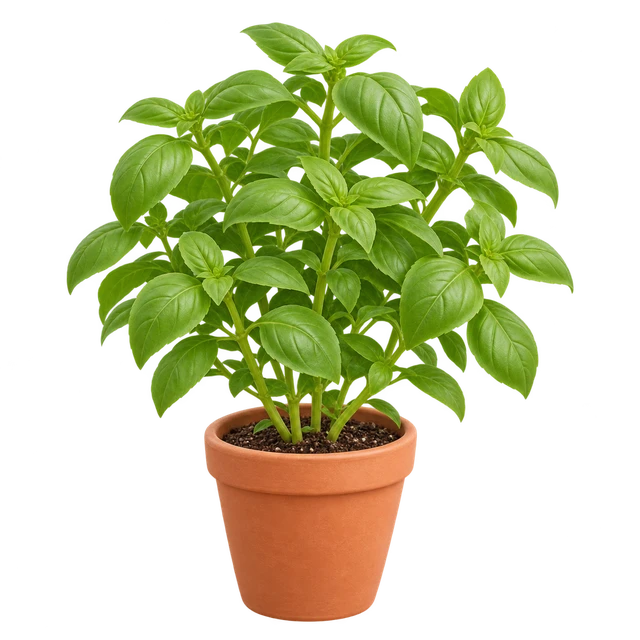
How do you water basil without causing rot?
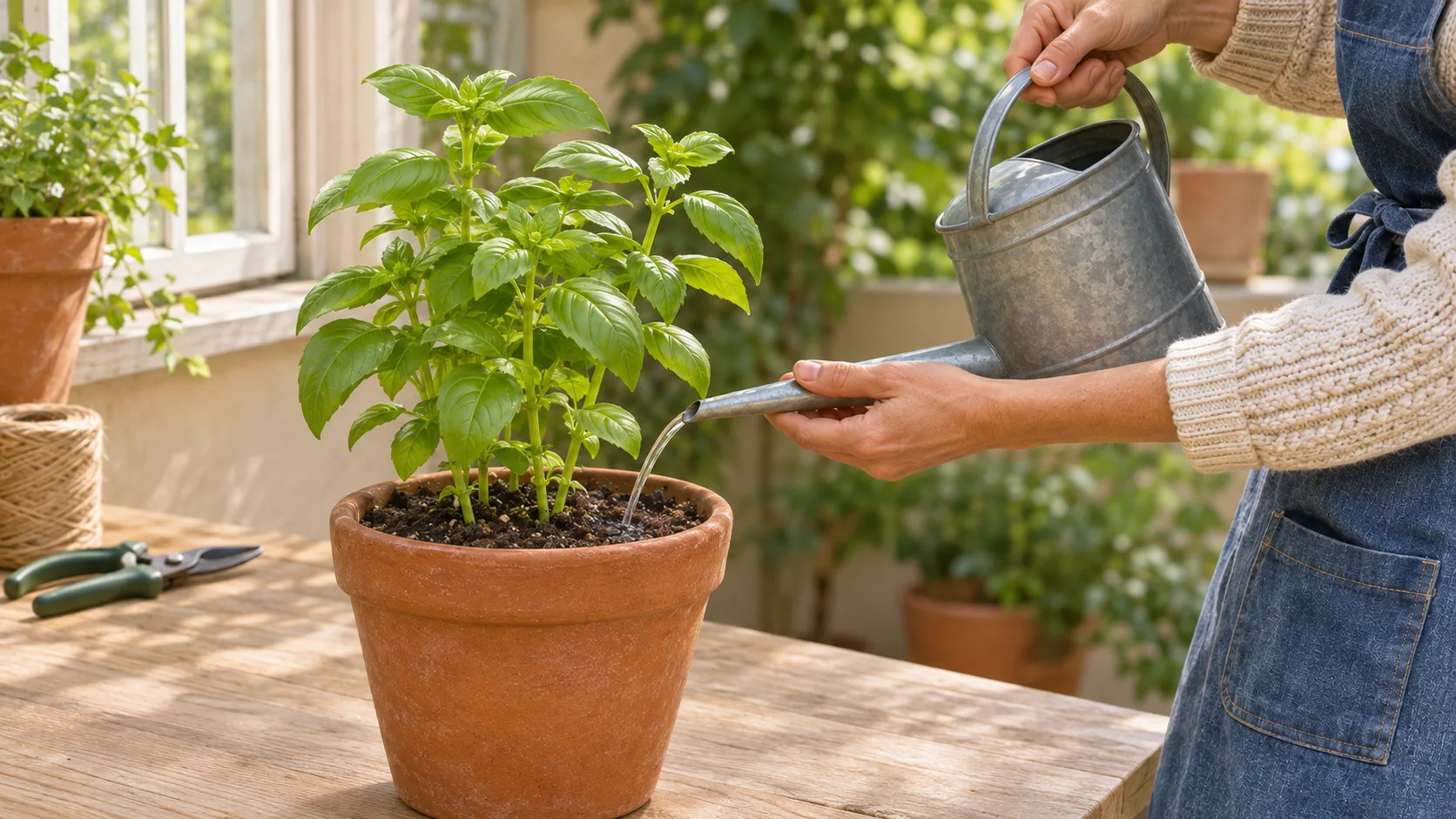
Keep the mix slightly moist, without drying out the whole root ball or leaving roots standing in water. Water at the base, preferably in the morning, without splashing the leaves. Adjust the rhythm to the pot, heat and soil. 1 2
10 L every 30 days
Water when the mix starts drying
Water during dry periods
Where should you grow basil, indoors or outdoors?
Give basil a warm, bright position with around six to eight hours of sun. In a scorching location, favour morning sun. Gradually acclimatise plants raised under cover, then avoid contact with cold window glass indoors. 3 4 5 2
6 h of direct sun per day: minimum reached
Sources: Penn State Extension
Garden exposure
Choose the side of the house where basil will grow, then count the hours of direct sun on a clear day.
When and how should you plant basil in pots or the garden?
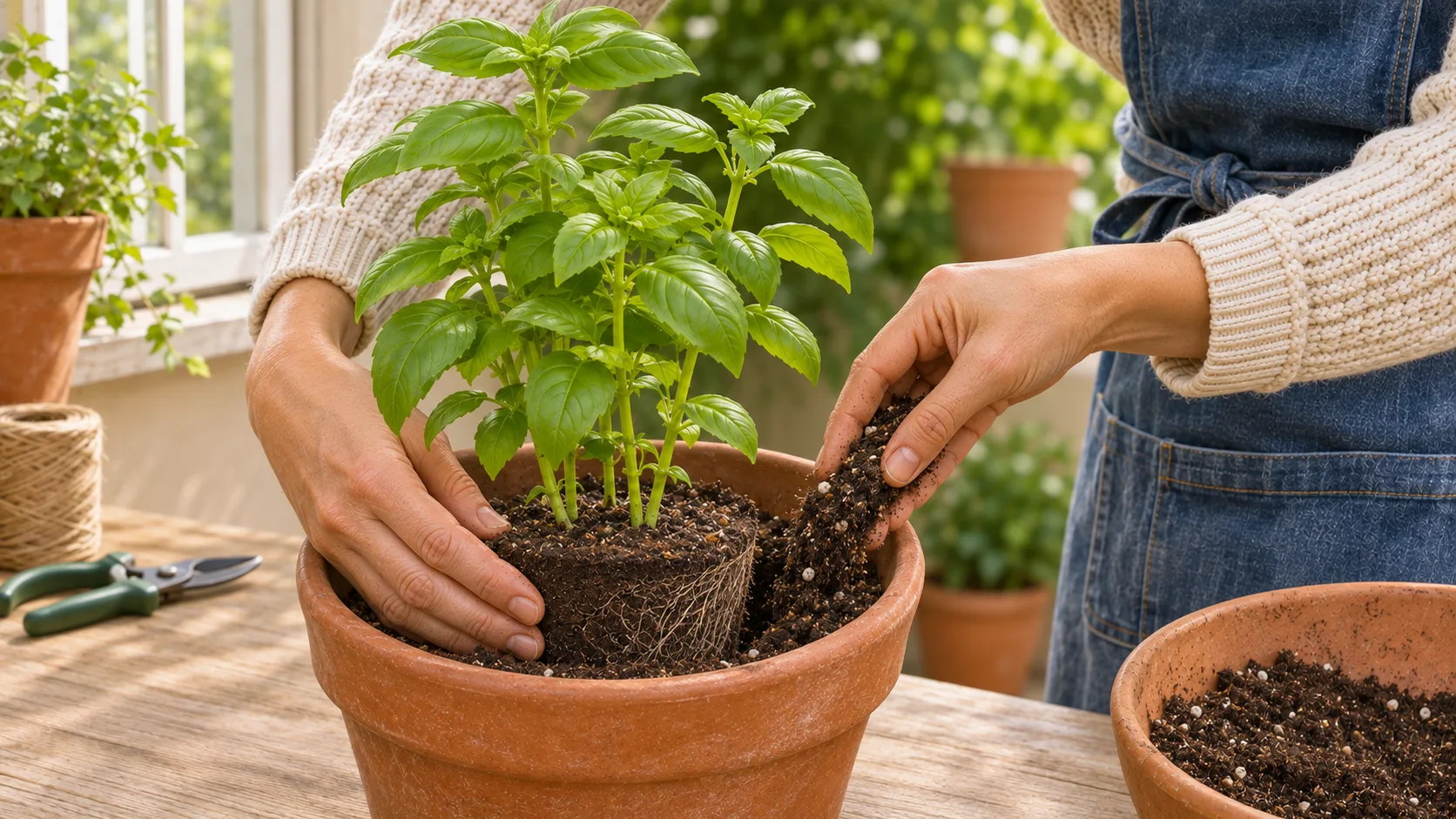
Plant after frost, with nights above 10 °C (50 °F), in a container with drainage at least 20 cm (8 in) wide and deep. Keep the original planting level. Promptly divide overcrowded shop-bought pots; as a plant-health precaution, keep these plants indoors. 1 5
Which fertiliser should you give basil?
Fertiliser is generally unnecessary in the garden; a balanced liquid feed can support harvests in a pot. Follow the bottle’s dose and account for nutrients already in the mix. Avoid excess nitrogen and high-potassium feeds when growing mainly for leaves. 1 6
- Fertilizer
- BalancedLiquidSource: Royal Horticultural Society
- Feeding
- During active growthin a potSource: Royal Horticultural Society
- Frequency
- Every 14 daysOr Brun OBRECLAROM250 · This product only, at 10 mL/L (0.35 UK fl oz per 0.22 UK gal) · in a potSource: SBM Life Science
- Avoid
- Excess nitrogen, applying fertilizer to a dry root ballSources: Iowa State University Extension; Algoflash
How do you prune basil to make it branch?
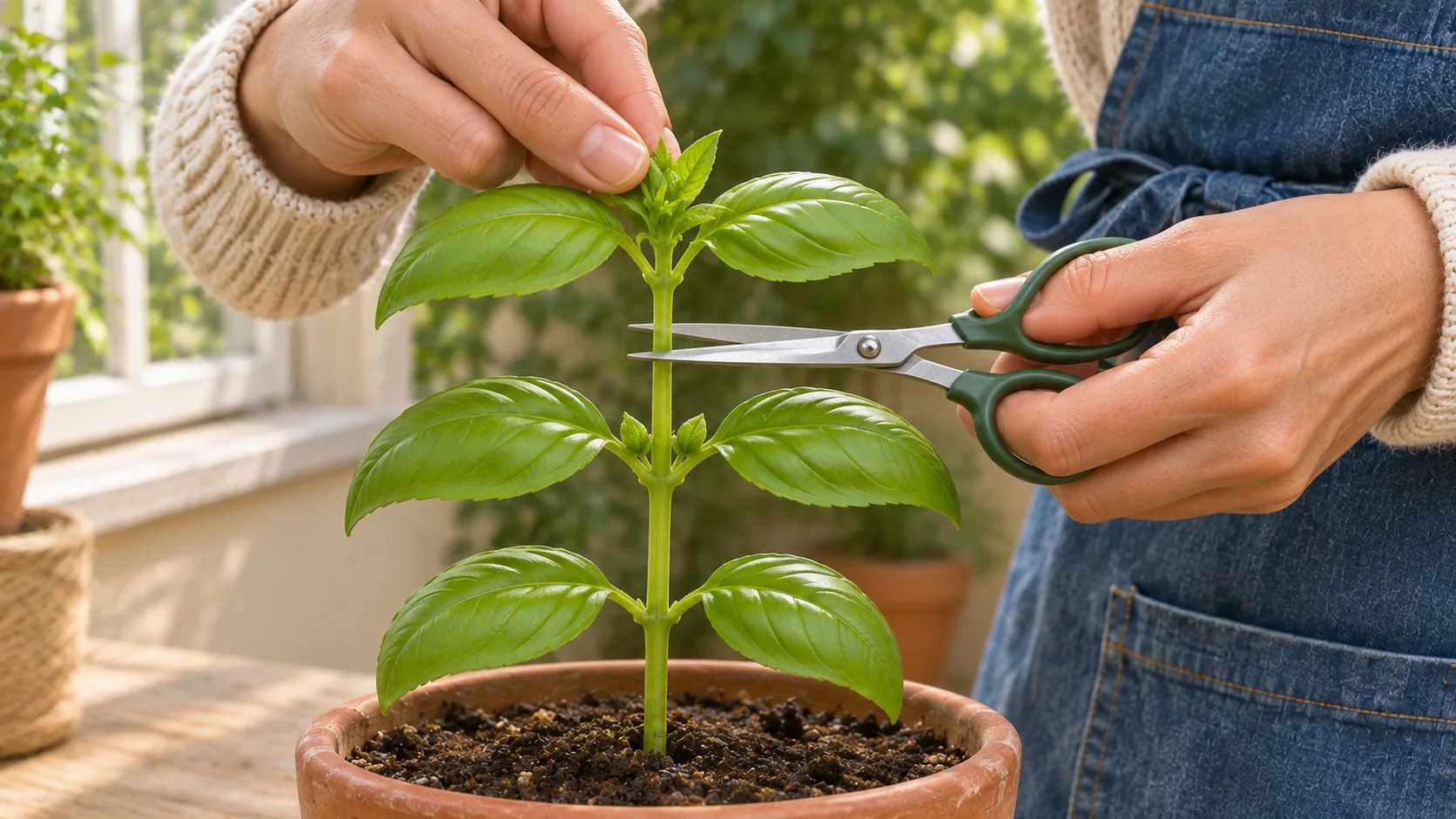
Harvest shoot tips above a pair of leaves, leaving two pairs at the base of the plant. The first pinch can begin at the six-leaf stage. Then harvest sufficiently developed side shoots rather than removing only the large leaves. 5 3
What temperatures can basil tolerate?
Protect basil at around 10 °C (50 °F) and before any frost. Grown as an annual in temperate climates, it can be kept in a bright, warm room, but winter harvests are not guaranteed. A cloche temporarily extends outdoor growing without replacing that shelter. 5 1 2
Temperatures for basil
In °C, thresholds given by the sources.
- Protect from cool nights10 °C
- Winter conditions
- Under cover, frost-freeSource: Royal Horticultural Society
- Bring indoors
- Before the first frostsin a potSource: Royal Horticultural Society
- Move back outside
- After the last frostsNights remaining above 10 °C (50 °F) · in a potSource: Royal Horticultural Society
- Light
- A bright roomSource: Royal Horticultural Society
When does basil flower, and should you remove the flowers?
Basil generally flowers in summer; drought and overcrowding can bring flowering forward. Remove flower stems as soon as they appear to prolong leaf harvests, or let one plant flower for pollinators. 1
- Flowering
- In summerRHS reference, United Kingdom · Mid- to late summer; British calendarSource: Royal Horticultural Society
How large does basil grow, and when should you harvest?
Basil reaches about 30 to 90 cm tall (1 to 3 ft), depending on selection and training; harvesting tips keeps it more compact. Common basils can spread about 30 to 60 cm (1 to 2 ft). Leave this space around the plant, even if its young nursery pot looks small. 5 7
- Mature height
- 30 to 90 cm
- Growth
- Fast
Harvesting starts on sufficiently leafy stems: a plant bearing 6 to 8 leaves can provide a first cut, provided leaves remain in place. Spread harvesting between plants rather than always exhausting the same one. 8
Leaf number is a guide to development here: it avoids harvesting too early from a still-sparse stem. The cut must retain a leafy base, rather than just a bare stem section. When several plants grow together, alternating harvests gives cut shoots time to replace foliage. 8
Pick in the morning before flowers open, and handle foliage gently. For a large harvest, choose healthy, branching tips; spotted leaves need examining first. An elongated stem does not necessarily provide more usable leaves. 7
Which care calendar should you follow in France?
Sow in warmth in March or April, move outdoors after frost, then harvest during the warm season. Sowing needs 18 to 20 °C (64 to 68 °F); cooler regions keep seedlings under cover longer. 5
| Task | January | February | March | April | May | June | July | August | September | October | November | December |
|---|---|---|---|---|---|---|---|---|---|---|---|---|
| Watering | reduced | reduced | reduced | moderate | moderate | high | high | high | moderate | reduced | reduced | reduced |
| Growth | resting | resting | resting | active | strong | strong | strong | strong | active | resting | resting | resting |
| Feeding | no | no | no | yes | yes | yes | yes | yes | no | no | no | no |
| Repotting | no | no | favorable window | favorable window | favorable window | no | no | no | no | no | no | no |
In spring, mainly monitor small pots' moisture and seedlings' light. When nights become mild enough, acclimatise plants, then set them outdoors. In summer, harvest tips, check water and remove flower buds from plants grown for foliage. 1
To extend harvests, sowing under cover can be staggered from March to July. Keep successive batches warm and bright, then repot young plants when they bear several leaves. Plants at different stages let you keep picking as the first plants reach flowering. 1
In late summer and autumn, falling temperatures limit outdoor growing. Bring pots you still want to harvest into a bright place before cold arrives. A vegetable-garden basil calendar remains that of a seasonal crop; it does not describe a plant living outside all year. 1
How do you propagate basil?
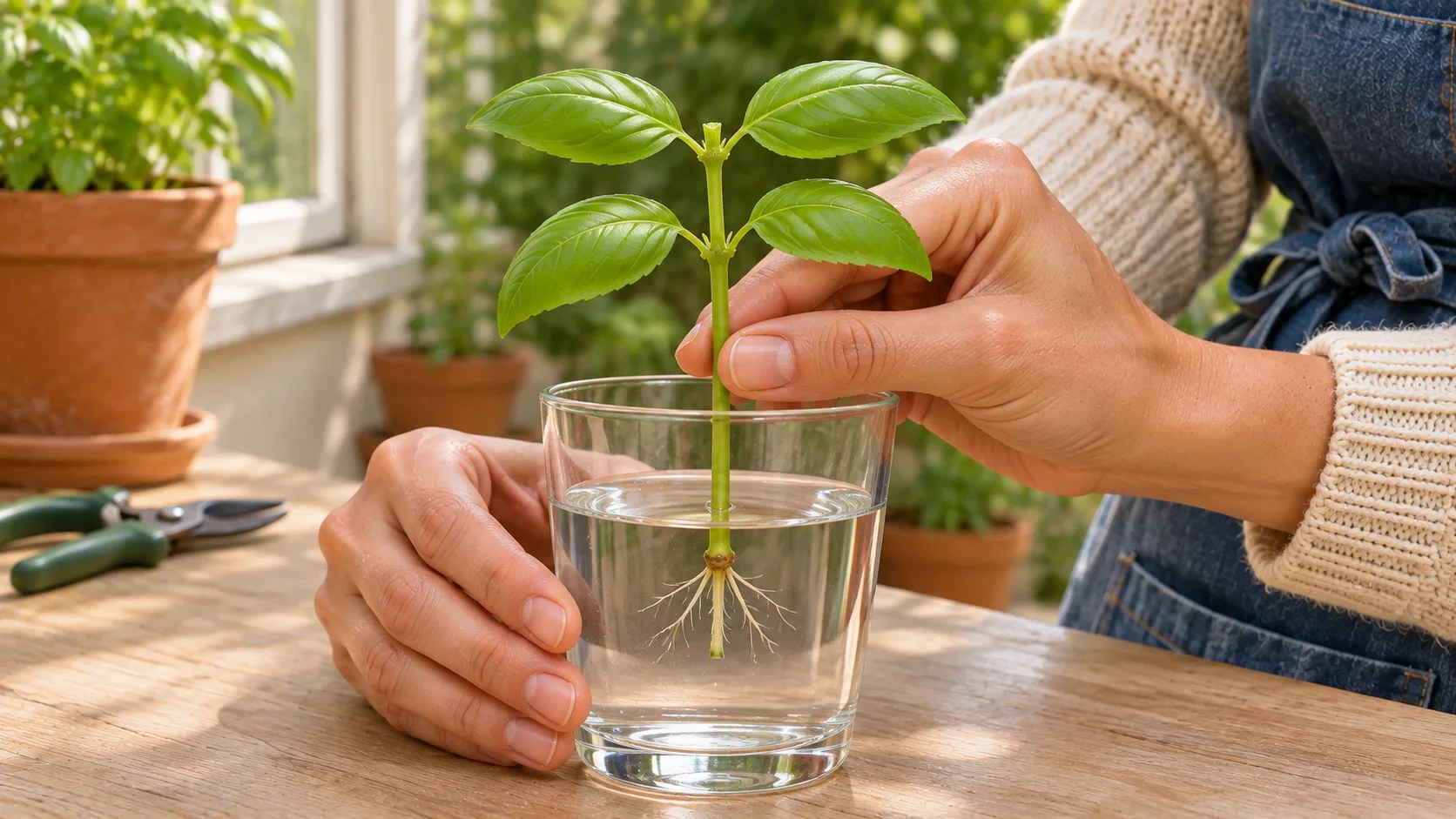
Renew basil from seed or soft, non-flowering shoot cuttings. Sow in warmth and light. For a cutting, cut below a leaf insertion, remove the lower leaves and keep the remaining foliage above the water while roots develop. 1
- Softwood cutting
- In summerroots well in waterSource: Royal Horticultural Society
- Sowing seed
- March and AprilindoorsSource: SNHF
Yellow, black or holed leaves: what should you check?
Inspect the root ball and leaf undersides before adding water or fertiliser. Downy mildew may begin with yellowing between the veins that resembles a nutrient deficiency; grey growth underneath changes the diagnosis. 6
| Observed sign | Possible cause to check | First action |
|---|---|---|
| Limp leaves, dry soil | Underwatering | Water at the base and resume checking the root ball. 8 |
| Decline in constantly wet mix | Root rot | Correct watering and water escape. 8 |
| Yellowing between veins, grey growth underneath | Basil downy mildew | Bag and remove the affected plant, then improve airflow around neighbours. 6 |
| Spots and leaf drop, dark streaks on stems | Shoot disease | Space plants for better airflow and keep them dry. 8 |
| Holes in leaves, slugs or snails present | Mollusc damage | Inspect plants and reduce damp clutter around foliage. 6 |
| What you see | Likely cause | What to do |
|---|---|---|
| Soil stays soggy, suffocating roots and causing rot. | OverwateringExternal Factors | Treating Waterlogged Soil |
| The plant wilts and yellows while the soil stays wet. | Root RotDiseases | Treating Waterlogged Soil |
| Small pear-shaped insects, often clustered on new growth. | AphidsPests | Eliminate Aphids |
| Nocturnal pests leaving shiny slime trails on leaves. | Snails and SlugsPests | Eliminate Slugs and Snails |
| Oily, angular spots confined by leaf veins. | Bacterial Angular Leaf SpotDiseases | Stop Bacterial Leaf Spot |
Is basil toxic?
Basil leaves are edible; the plant is classified as non-toxic to cats and dogs. This classification does not cover concentrated essential oils. Wash leaves intended for cooking. 1 9 2
Which basil varieties should you choose?
Choose aroma first, then habit and disease resistance. Labels such as “Thai”, “purple” or “lemon” cover several selections; a precise cultivar name makes choosing more reliable. 6
Genovese
Stable cultivar
Large-leaved Italian type, a standard for pesto.
Thaï
Horticultural name
Aniseed and spicy profile for Thai cooking.
Pourpre
Horticultural name
Purple foliage, culinary use and ornamental contrast.
Citron
Horticultural name
Lemon aroma, best harvested young.
Varieties documented in the botanical profile.
| Type or cultivar | Distinctive feature | Consequence for choosing |
|---|---|---|
| ‘Genovese’ | Large green leaves, upright habit, fairly slow to flower | Suits harvesting large leaves; monitor downy mildew, to which it is susceptible. 6 |
| Thai, particularly ‘Siam Queen’ | Narrower leaves, purple stems and flowers, anise aroma | Choose this scent for dishes needing a liquorice note. 6 |
| Purple, particularly ‘Dark Opal’ | Dark decorative, edible foliage | Identify the selection rather than buying colour alone. 7 |
| ‘Greek Dwarf’ | Compact habit about 15 cm tall (6 in), small leaves | A choice for small spaces and pot edges. 10 |
| ‘Nufar’ | Fusarium wilt resistance | Useful where this disease is a problem, without protection against every disease. 6 |
Lemon basil can also mean Ocimum × africanum, a hybrid distinct from sweet basil. Check the taxon on the label before assigning it the characteristics of an O. basilicum cultivar. 6 The basil botanical profile adds identification criteria.
Frequently asked questions
What is the best way to keep cut basil fresh?
How do you freeze fresh basil?
Put leaves in a freezer bag, expel the air, then close it. You can also chop them, divide them into an ice-cube tray and add a little water before freezing. Transfer frozen cubes to a sealed bag; they can then be portioned without thawing the entire supply. 3