
Care guide
Jade plant care
Crassula ovata
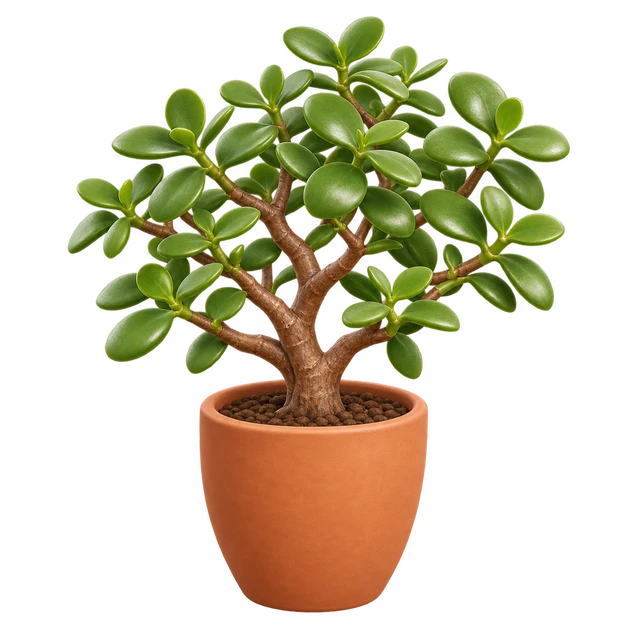
A jade plant stays compact with at least four hours of sunlight and a root ball that dries between waterings. A pot with drainage holes, little fertiliser and a bright winter help prevent soft leaves and elongated stems. Keep this succulent away from pets: it is toxic to cats, dogs and horses.
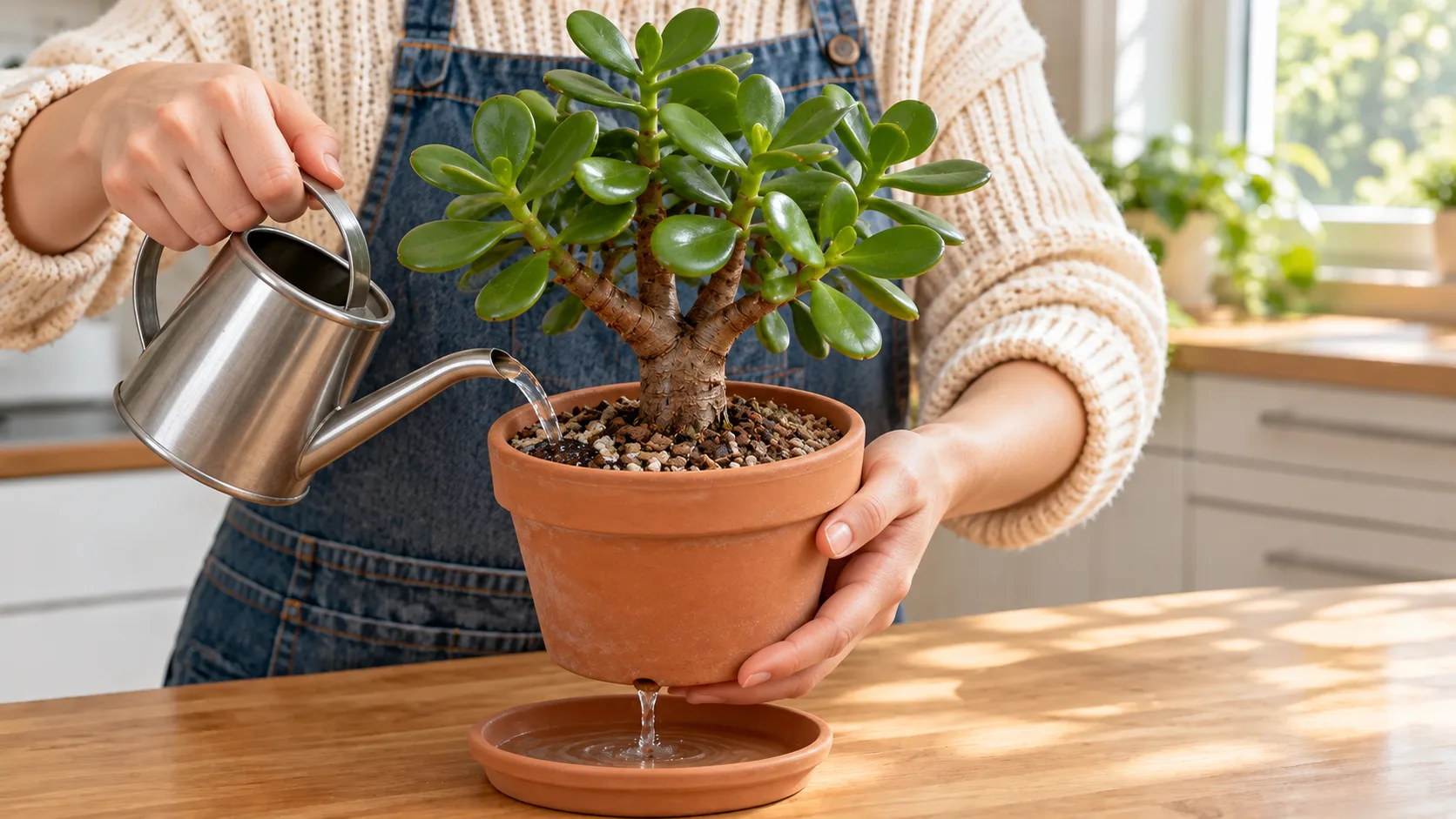
How often should you water a jade plant?
Wait for the mix to dry, then water until it drains out. Use room-temperature water and empty the saucer after about fifteen minutes. Reduce watering in winter without letting the leaves become badly wrinkled.12
17 cL every 16 days
Water thoroughly after the potting mix dries
Water less often; prevent leaves from shrivelling
Where should you put a jade plant?
At least four hours of direct sunlight help keep a jade plant compact, after acclimatisation. A south-facing window suits it; protect existing leaves from a sudden move into intense sun.32
The aloe vera guide helps compare the needs of neighbouring succulents.
Which soil should you use, and when should you repot?
Choose a porous mix and a stable pot with drainage holes. Jade plants tolerate crowded roots; reassess the container every two to three years, or if it topples.24
- Repot
- Every 2 to 3 yearsSource: University of Wisconsin Extension
- When to repot
- In springAs growth beginsSource: University of Wisconsin Extension
- The new pot
- 2,5 to 5 cm widerDiameter and depth <25 cm (10 in); maximum +1/3 for any potSource: Royal Horticultural Society
Which fertiliser should you give a jade plant?
Cactus fertiliser at half-strength, three times during growth, is one possible programme.1 Avoid high-nitrogen formulas and feeding a completely dry root ball.5 After repotting, wait four months.13
- Feeding
- April to SeptemberOnly on a growing plantSource: University of Connecticut
- No fertilizer
- During dormancySource: Royal Horticultural Society
- Frequency
- Every two monthsApril to September, while the plant is growingSource: University of Connecticut
- Frequency
- Three feeds during growthHalf-strength cactus fertiliserSource: New York Botanical Garden
- Avoid
- Exceeding the dose on the label, excess nitrogen, feeding immediately after repotting, feeding during dormancy, applying fertilizer to a dry root ballSources: New York Botanical Garden; Clemson Cooperative Extension HGIC; Royal Horticultural Society; Colorado State University Extension
The plant fertilising guides cover other feeding routines.
When and how should you prune a jade plant?
Pruning is optional; work in early spring to adjust the shape. Cut above a node or branch junction with a clean tool, removing no more than a third of the growth at once.61
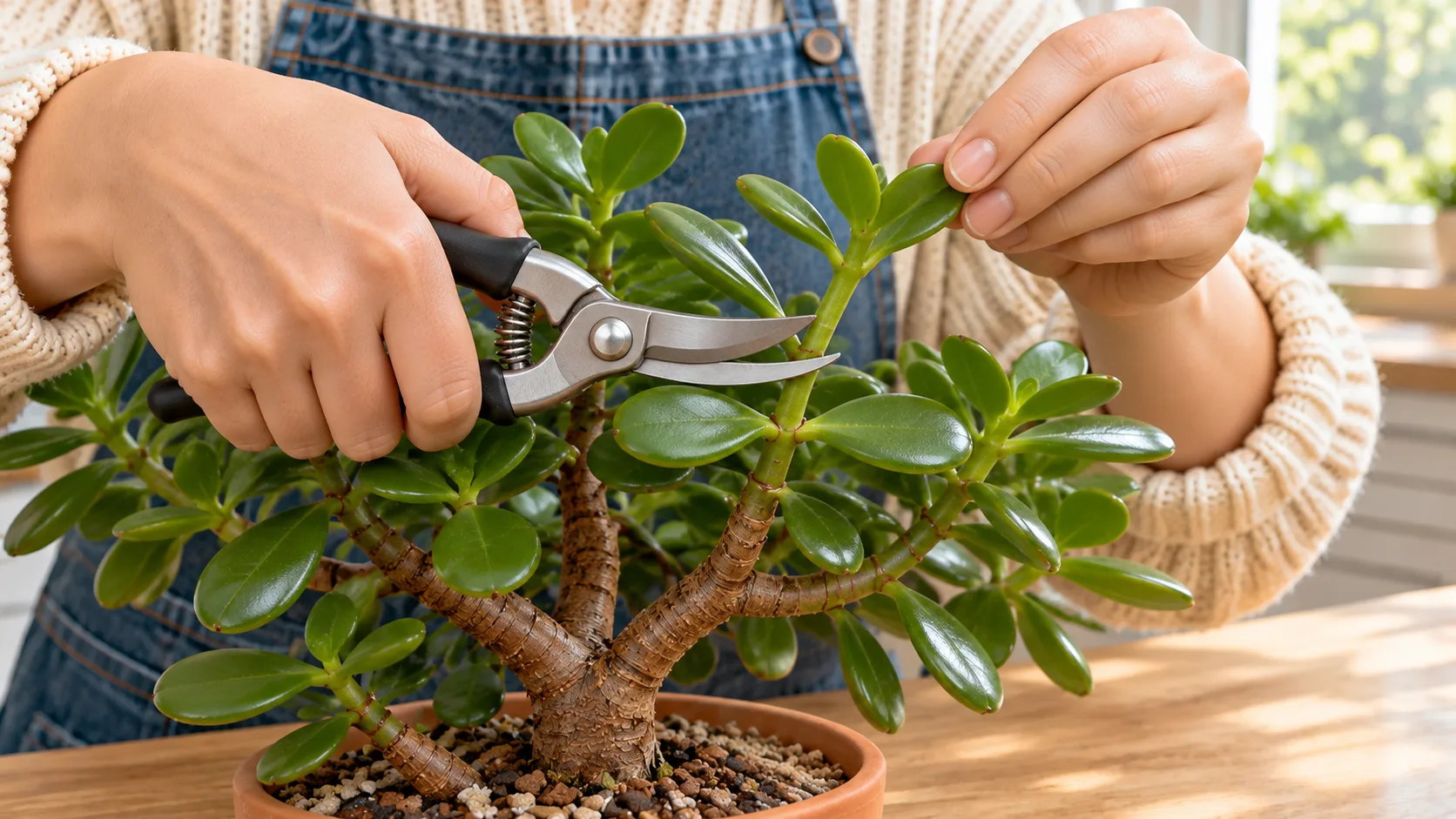
Compare different habits in the plant pruning guides.
What temperatures can a jade plant tolerate?
Keep a jade plant above 10 °C (50 °F) and bring it indoors before the first frosts. Avoid draughts and leaves touching cold glass. Winter light is still necessary despite reduced watering.721
Temperatures for jade plant
In °C, thresholds given by the sources.
- Recommended minimum for indoor growing10 °C
- Cool conditions around 13 °C, especially at night13 °C
- Ideal: 18 to 24 °C
- Winter conditions
- Under cover, frost-freeSource: University of Wisconsin Extension
- Bring indoors
- Before the first frostsSource: University of Wisconsin Extension
- Move back outside
- After the last frostsAcclimatise gradually to sunSource: Floralens guide
- Light
- A bright roomSource: New York Botanical Garden
- Winter watering
- Just enough to prevent shrivelled leavesWinter rest in low lightSource: New York Botanical Garden
How large does a jade plant grow?
An old jade plant can reach about 1.5 m (5 ft) indoors. The species' horticultural dimensions reach 2.5 m (8 ft) tall and 1 to 1.5 m (3 to 5 ft) across. It grows slowly: allow stable space for its branches and support the pot when moving it.368
- Mature height
- 1,5 to 2,5 m
- Spread
- 1 to 1,5 m
- Growth
- Slow to moderate
When does a jade plant flower?
Long, cool nights with strong daytime light encourage buds. Reduce watering for several weeks of preparation without excessively drying out the jade plant. Clusters of white or pink flowers remain rare indoors.21
- What triggers flowering
- Long nightsSource: University of Wisconsin Extension
- Flowering
- In winterIndoors, mature plant · Bright light; rare flowering indoors · indoorsSource: Clemson Cooperative Extension HGIC
- Flowering
- In springObserved in outdoor cultivation · Spring outdoors, not an indoor calendarSource: NC State Extension Gardener Plant Toolbox
The month-by-month care calendar
Support growth in spring and summer; reduce water and fertiliser during winter rest. The start of new growth suits repotting and pruning. In autumn, bring the pot indoors before frost, then keep it in a bright place.217
| Task | January | February | March | April | May | June | July | August | September | October | November | December |
|---|---|---|---|---|---|---|---|---|---|---|---|---|
| Watering | reduced | reduced | moderate | high | high | high | high | high | moderate | moderate | reduced | reduced |
| Growth | resting | resting | active | active | active | strong | strong | active | active | resting | resting | resting |
| Feeding | no | no | no | yes | yes | yes | yes | yes | yes | no | no | no |
| Repotting | no | no | favorable window | favorable window | favorable window | no | no | no | no | no | no | no |
How do you propagate a jade plant?
A stem or whole leaf can root after a few days of wound drying. Then use a free-draining mix and avoid soaking the base. Spring and summer suit this propagation.26
- Stem segment cutting
- In summerLet heal for a few days; fairly dry potting mixSource: University of Wisconsin Extension
- Leaf cutting
- In springSource: Royal Horticultural Society
- Leaf cutting
- In summerLet heal for a few days before pottingSource: University of Wisconsin Extension
- Sowing seed
- In springSource: University of Wisconsin Extension
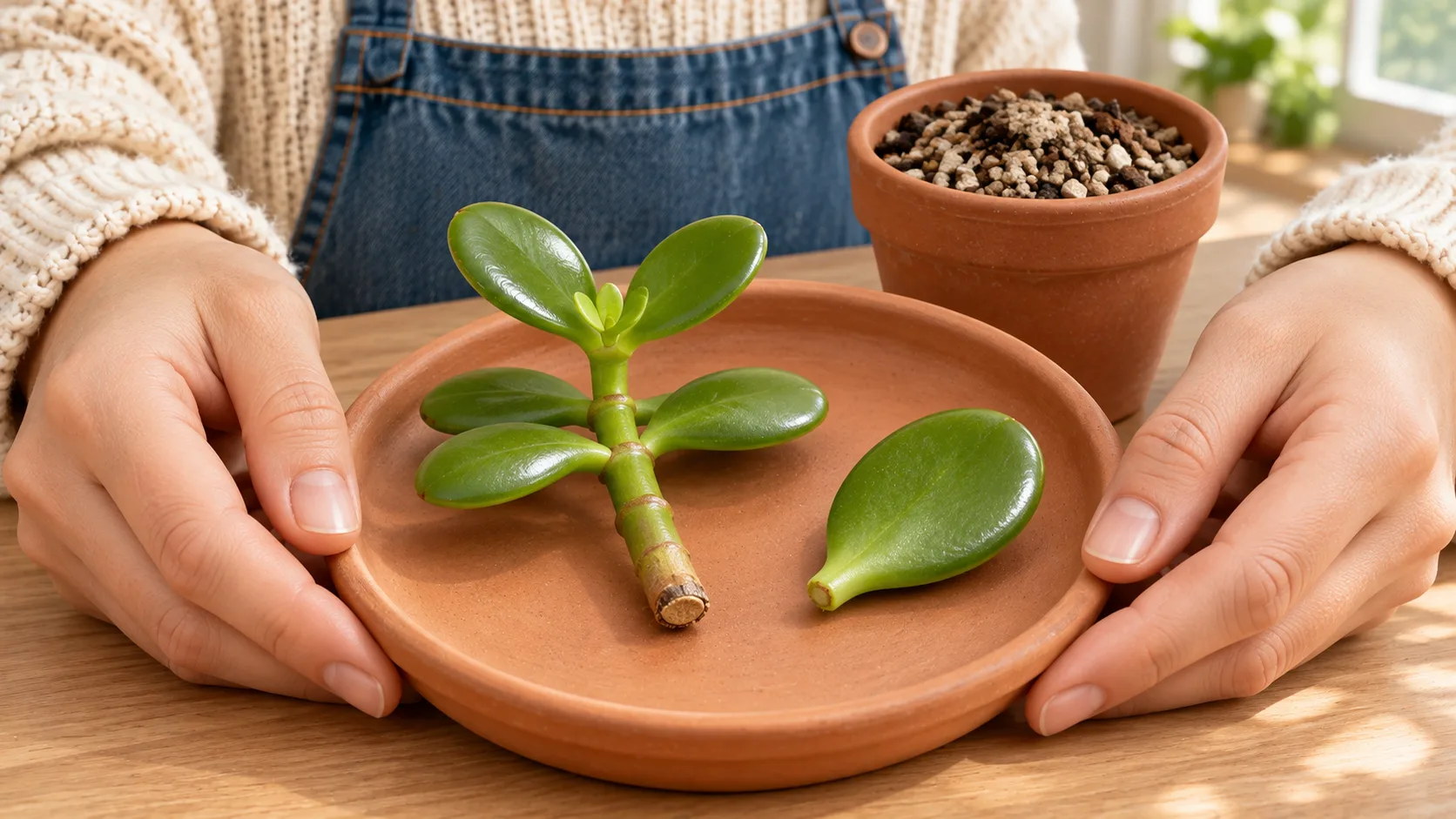
Follow the practical steps for propagating a jade plant , from taking a cutting and letting it dry to planting it in the mix.
Common problems: diagnosis
Check the pot and tissues before treatment. Excess moisture, mealybugs or oedema can produce different signs. A cultivar's colour is not a disease.24
| Observed sign | Cause to check | First action |
|---|---|---|
| Falling leaves, wet soil, soft base | Overwatering and root rot2 | Stop watering, examine the roots and correct drainage |
| Wrinkled leaves, soil dry for a long time | Dehydration1 | Water and let drain; resume checking drying |
| Small white cottony clusters in leaf axils | Mealybugs3 | Isolate the pot and remove accessible insects |
| Dull, finely speckled foliage | Mites3 | Inspect leaf undersides and isolate the affected plant |
| Blisters followed by brown corky patches | Oedema linked to excessive water uptake4 | Reduce watering and improve light and ventilation |
| Whitish powdery areas and crusts | Possible powdery mildew1 | Isolate and confirm the diagnosis before using a product |
| Long, thin, leaning stems | Insufficient light2 | Acclimatise to a brighter window, then prune in spring |
Compare the signs of overwatering and mealybugs.
| What you see | Likely cause | What to do |
|---|---|---|
| Soil stays soggy, suffocating roots and causing rot. | OverwateringExternal Factors | Treating Waterlogged Soil |
| The soil is dry and leaves are soft and drooping. | UnderwateringExternal Factors | Rescue by Soaking |
| White cottony clumps in leaf axils and on stems. | MealybugsPests | Eliminate Armored Scale Insects |
| The plant stretches, turns pale, and leans toward the window. | Low LightExternal Factors | Increase light |
Is a jade plant toxic?
Jade plants are toxic to dogs, cats and horses: call a vet after suspected ingestion. For human ingestion in France, contact the poison centre on 01 45 42 59 59 without waiting for symptoms.910
See also jade plant risks.
Which jade plant variety should you choose?
Choose according to foliage and size: tubular forms change the outline, while variegation changes the colour. A red margin on ordinary leaves is not enough to identify a cultivar.82
Gollum
Stable cultivar
Cultivar with tubular leaves, often reddish at the tips.
Hobbit
Stable cultivar
Spoon-shaped or partly rolled leaves, compact habit.
Hummel's Sunset
Stable cultivar
Green leaves edged yellow and tinted red; shrub 0.5 to 1 m tall (2 to 3 ft).
Crosby's Compact
Stable cultivar
Compact form with small rounded leaves.
Botany Bay
Stable cultivar
Bushy habit, light green leaves with red tips.
Pink Beauty
Stable cultivar
Selection with small leaves and pink flowers.
2 more varieties documented in the botanical profile.
The following features help compare a label with the plant on sale.
| Cultivar | Distinctive feature | What it changes when buying |
|---|---|---|
| 'Gollum' | Tubular leaves ending in a small suction cup8 | An outline of branching fingers |
| 'Hobbit' | Spoon-shaped leaves folded inwards8 | Curled foliage to compare closely with 'Gollum' |
| 'Hummel's Sunset' | Green leaves edged yellow and tinted red; about 0.5 to 1 m (2 to 3 ft)11 | A colourful specimen smaller than large jade plants |
| 'Crosby's Compact' | Compact habit, small rounded leaves8 | A choice for a smaller position |
| 'Tricolor' | Pointed leaves streaked cream and pink3 | Variegation to examine across several branches |
Also check for white fluff in the axils and a firm base. Very dark green leaves with loose stems mainly indicate insufficient light, rather than a rare variety.2
Frequently asked questions
Leaf colour and the plant's age offer clues, read alongside its position and the state of the pot.2